Content
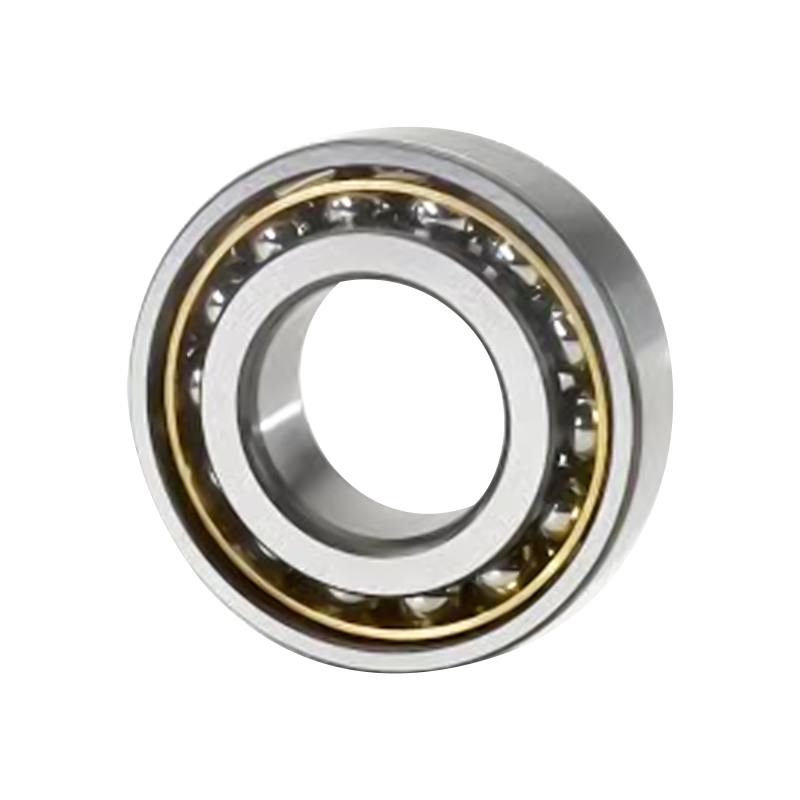
The 3200 A-2ZTN9/MT33 double row angular contact ball bearing is designed for machinery that must manage radial loads, axial loads in both directions, and overturning moments within a compact installation envelope. It combines the functional advantages of two single row angular contact ball bearings with the space-saving benefits of a single, integrated bearing unit. This makes it a practical solution for automotive wheel hubs, pumps, compressors, gearboxes, transmission systems, and machine tool assemblies where stiffness, controlled axial positioning, and dependable rotation are essential.
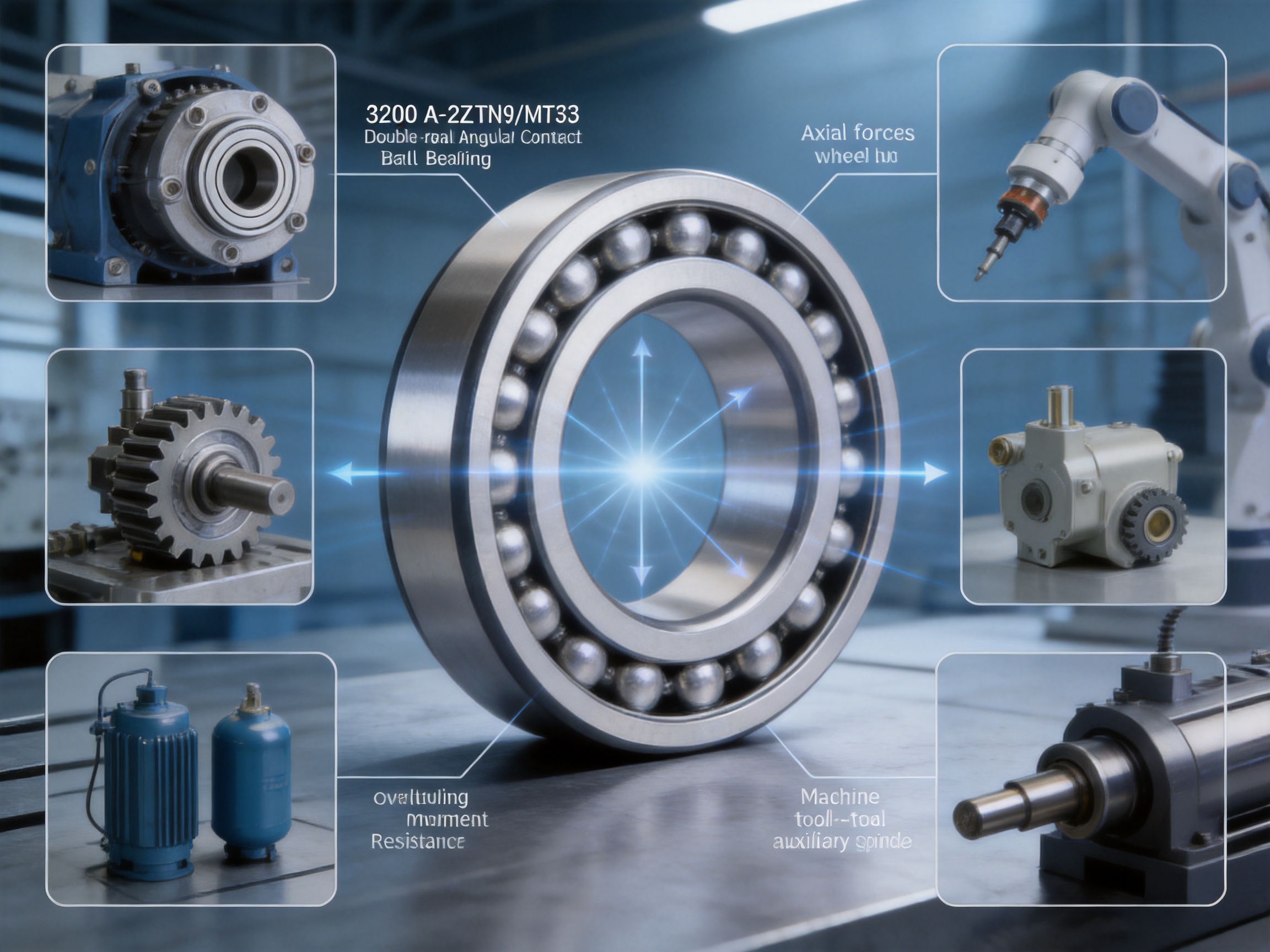
Unlike a basic deep groove ball bearing, an angular contact bearing is designed so that the rolling elements transmit load through a defined contact angle. This geometry enables the bearing to support radial loads while also carrying axial forces. In the double row arrangement, the two rows of balls form a bearing system capable of resisting axial displacement in both directions. The result is a rigid bearing arrangement that can accommodate combined loading without requiring the same axial space as two separate single row bearings installed in a back-to-back configuration.
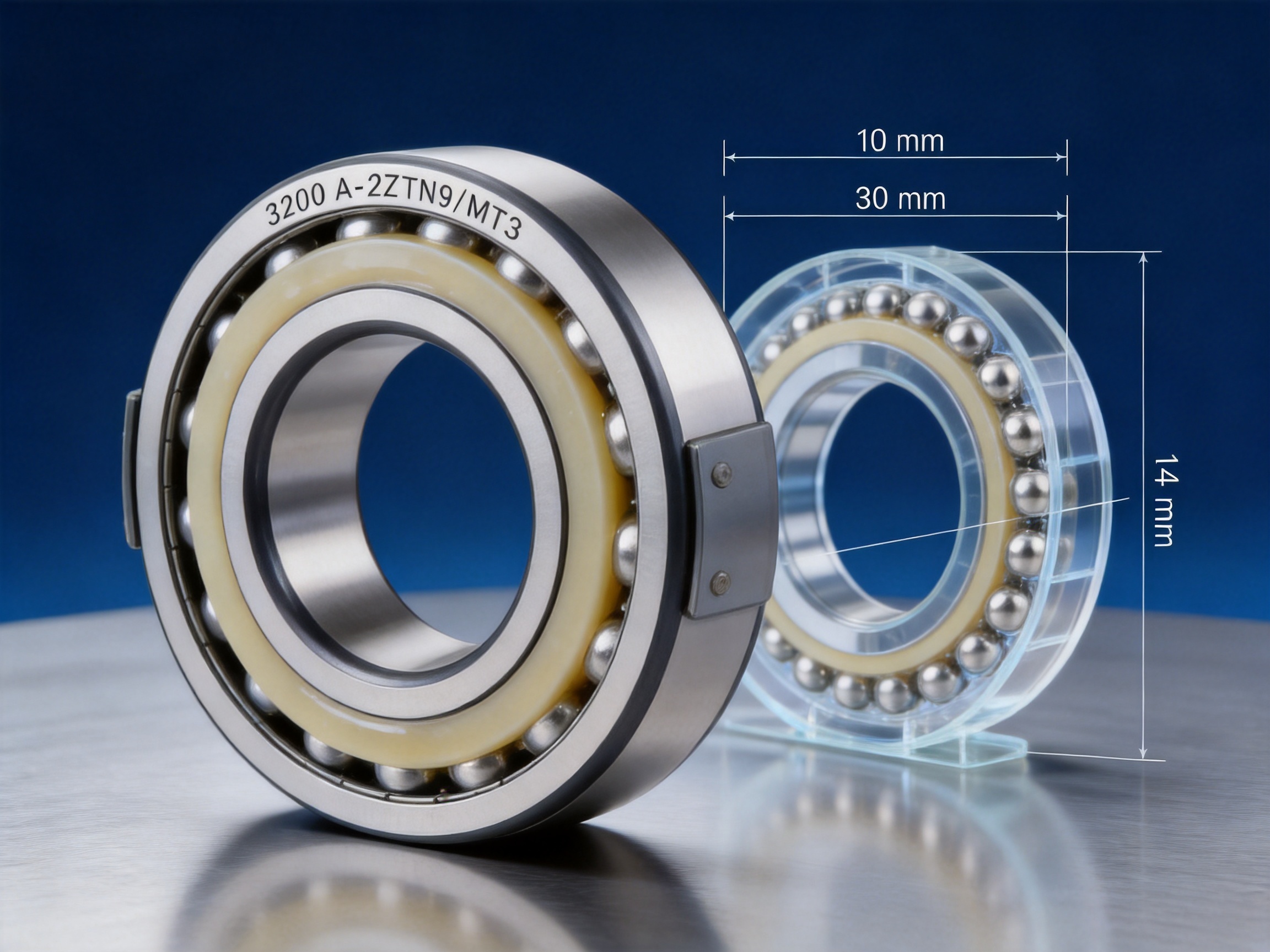
The 3200 A-2ZTN9/MT33 designation identifies a specific configuration within the 3200 series. The bearing has a 10 mm bore, a 30 mm outside diameter, and a 14 mm width. Its listed dynamic load rating is 6.849 kN, while its static load rating is 3.87 kN. The reference speed is listed as 23,400 revolutions per minute, and the limiting speed is 21,600 revolutions per minute. Its listed mass is approximately 0.051 kg. These values make the bearing suitable for compact, high-speed mechanisms where dimensional accuracy and low rotational resistance are important.
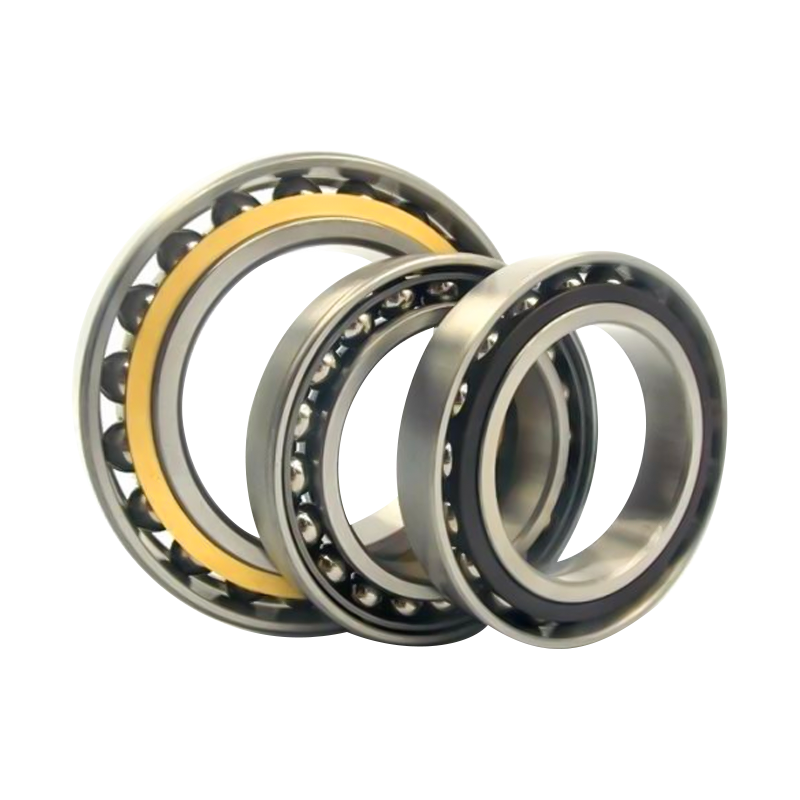
A double row angular contact ball bearing can be understood as an integrated alternative to a matched pair of single row angular contact bearings. Two rows of balls are arranged within a common inner ring, outer ring, and cage structure. The internal geometry creates two angular contact paths, allowing the bearing to carry loads from different directions while maintaining a stable shaft position.
In many mechanical systems, a single bearing is not sufficient to control axial movement. A conventional radial bearing may carry a radial load effectively but provide limited axial location, especially when the operating load reverses direction. A pair of single row angular contact bearings can solve this issue, but the arrangement normally requires two bearing positions, additional spacers or shoulders, more assembly work, and a greater axial installation length. The double row design integrates these functions into one component.
The typical contact angle of approximately 30 degrees gives this type of bearing a useful balance between radial and axial load capacity. A larger contact angle generally improves axial load capability, while the double row structure contributes to stiffness and resistance to tilting. The bearing can therefore support a combination of forces that may include shaft weight, belt tension, gear forces, hydraulic loads, and axial thrust.
Another important characteristic is the ability to resist overturning moments. An overturning moment occurs when an external force acts at a distance from the bearing’s centerline. This creates a tendency for the shaft or housing to tilt. Because the two rows of rolling elements are distributed across the bearing width, the bearing can develop a stabilizing reaction against this tendency. Proper shaft and housing support remain essential, but the bearing geometry provides a strong foundation for rigid mechanical design.
The 3200 series is particularly useful where the designer needs a relatively narrow bearing with a moderate outside diameter. The 3200 A-2ZTN9/MT33 version has metal shields on both sides, helping protect the internal lubricant and rolling paths from ordinary dust and handling contamination. The shielded configuration is suitable for many applications in which the bearing is factory lubricated and additional relubrication is not required during normal service.
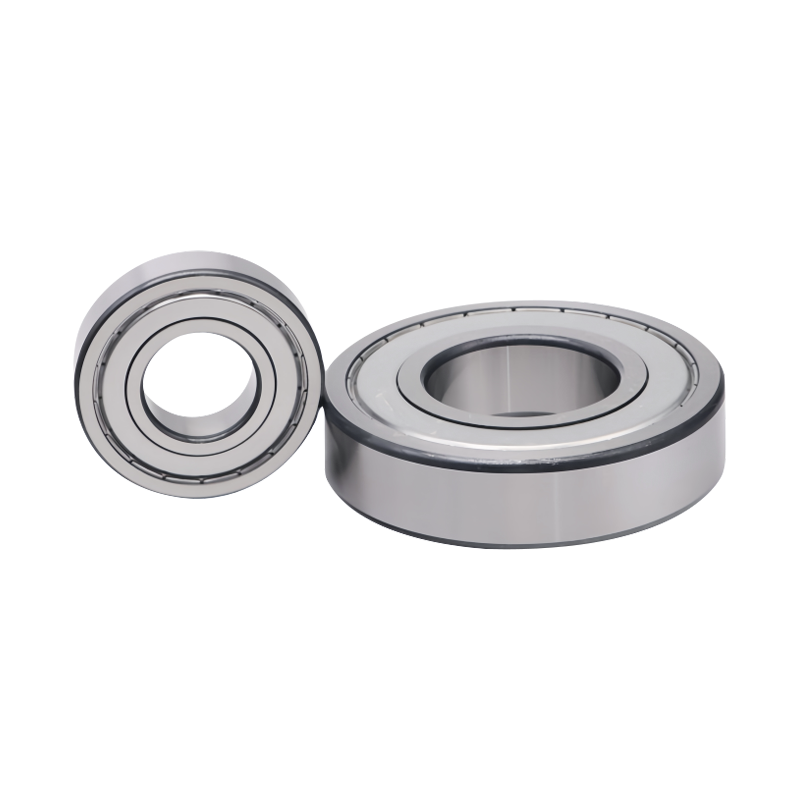
3200 A-2ZTN9/MT33 Double Row Angular Contact Ball Bearings
The principal advantage of the 3200 A-2ZTN9/MT33 is its compact axial form. With a width of 14 mm, it can fit into assemblies where the available shaft length is limited. Replacing two single row bearings with one double row bearing may reduce the space needed for shoulders, spacers, locknuts, seals, and retaining components.
Reducing axial space can also simplify the overall mechanical layout. A shorter bearing seat may permit a more compact housing, a shorter shaft, or a smaller protective cover. In equipment where every millimeter affects packaging, weight, and manufacturing cost, this can be a significant engineering advantage.
The bearing can accommodate axial forces acting in both directions. This is valuable in systems where thrust may reverse during operation, such as gearboxes, rotating actuators, electric motor assemblies, and vehicle wheel hubs. A bearing arrangement that can manage bidirectional axial movement reduces the need for a second locating bearing or a separate thrust-control component.
Bidirectional capacity does not mean that every application can apply unlimited axial force. Load magnitude, load direction, speed, temperature, lubrication, internal clearance, mounting accuracy, and operating shock must all be evaluated. Nevertheless, the integrated double row geometry provides a more complete load-carrying function than a standard radial bearing of similar size.
Rigidity is essential when shaft deflection or angular movement must be controlled. Excessive deflection can cause gear mesh errors, seal damage, vibration, uneven raceway loading, and poor positioning accuracy. The two-row angular contact arrangement creates a broad reaction structure that helps maintain shaft alignment under combined loading.
Compared with a single row angular contact bearing, the double row arrangement generally provides stronger resistance to tilting. Compared with two separate bearings, it can offer a more compact and controlled solution, although the final rigidity of any assembly also depends on the housing, shaft diameter, preload or clearance condition, clamping method, and support spacing.
Overturning moments are common in wheel hubs, pulley supports, robotic joints, gearbox shafts, and machine tool mechanisms. The moment may be generated by an external radial force acting away from the bearing center, or by an uneven load distributed around the housing. The internal spacing between the two rows allows the bearing to react to this moment with a stabilizing force pair.
For designers, this means the bearing can help reduce angular displacement without the axial length of a widely spaced bearing pair. It is especially helpful when the mechanism must remain compact but cannot sacrifice positional stability.
The 2Z designation indicates shields on both sides. Shields are non-contact protective elements that help limit the entry of ordinary dust and help retain grease inside the bearing. Because the shields do not normally rub against the inner ring, they can support relatively high speeds with lower friction than many contact-sealed configurations.
Shielded bearings are not intended for every environment. Where water spray, corrosive chemicals, abrasive particles, or heavy contamination are present, a contact-sealed design or a specially protected bearing may be more appropriate. The selection should be based on the actual operating environment rather than the designation alone.
The TN9 suffix is associated with a molded polyamide cage configuration commonly used in many high-speed bearing designs. A suitable cage helps guide and separate the balls, reduce ball-to-ball contact, and maintain stable rolling behavior. The MT33 suffix identifies a specified grease or lubrication configuration within the supplied product designation.
Lubricant selection has a direct influence on starting torque, running temperature, noise, service life, and high-speed performance. The bearing should be operated within the temperature and speed limits recommended for the actual grease and cage combination. If the application uses unusual temperatures, vacuum, aggressive chemicals, or rapid acceleration, a special lubrication review should be completed before installation.
The following data is provided for the 3200 A-2ZTN9/MT33 configuration. The values should be confirmed against the latest manufacturer drawing, quality certificate, and application-specific calculation before final design approval.
| Parameter | Value | Unit |
|---|---|---|
| Bore diameter | 10 | mm |
| Outside diameter | 30 | mm |
| Width | 14 | mm |
| Dynamic load rating, C | 6.849 | kN |
| Static load rating, C0 | 3.87 | kN |
| Reference speed | 23,400 | r/min |
| Limiting speed | 21,600 | r/min |
| Approximate mass | 0.051 | kg |
| Configuration | Double row angular contact, shielded | — |
The dynamic load rating is used in bearing life calculations under rotating load. It does not represent a permissible operating load by itself. The calculated life depends on the applied radial load, axial load, rotational speed, lubrication, contamination, alignment, temperature, and reliability target.
The static load rating is used when evaluating stationary or slowly rotating conditions, shock loads, and the risk of excessive permanent deformation at the rolling contacts. Applications involving impact, repeated stops, transport vibration, or heavy static loads should be assessed using the static safety factor as well as the dynamic rating.
The listed reference and limiting speeds are indicative values for the stated bearing configuration. Actual permissible speed can be lower when the bearing is subject to substantial axial load, high operating temperature, inadequate heat dissipation, unusual lubricant conditions, or severe mounting misalignment. For high-speed operation, a thermal balance calculation and vibration review are recommended.
A deep groove ball bearing is often a cost-effective general-purpose choice for moderate radial loads and limited axial loads. However, it may not provide the same level of bidirectional axial location or moment resistance as a double row angular contact bearing. When shaft position must remain controlled under combined loads, the 3200 A-2ZTN9/MT33 can offer a more suitable internal geometry.
The comparison should not be interpreted as meaning that the angular contact bearing is universally better. Deep groove bearings may be preferred for lower cost, simpler loads, lower axial requirements, or certain sealing arrangements. The advantage of the 3200 configuration becomes most evident when stiffness, axial control, and compactness are important design objectives.
Two single row angular contact bearings in a back-to-back arrangement can provide excellent stiffness and moment capacity. However, they require two individual components, carefully controlled orientation, suitable spacing, and a method of setting preload or axial clearance. The overall assembly can be wider and more expensive to install.
A double row bearing provides an integrated alternative. It reduces the number of parts, shortens the axial package, and simplifies assembly. It can also reduce the opportunity for installation errors such as incorrect bearing orientation, inconsistent preload, or contamination introduced between two separate components.
There are situations where two single row bearings remain preferable. A matched pair may permit adjustable preload, greater support span, easier replacement of one component, or customized internal clearance. The 3200 A-2ZTN9/MT33 is most attractive when the design requires integrated bidirectional capacity and compact dimensions rather than field-adjustable bearing spacing.
Cylindrical roller bearings generally offer high radial load capacity and good stiffness, but their ability to carry axial load depends strongly on the specific flange design. They may require a separate thrust bearing or locating arrangement. The double row angular contact bearing offers a more naturally integrated solution for simultaneous radial and bidirectional axial loads.
Tapered roller bearings are well suited to heavy combined loads and high moment resistance. They are widely used in automotive and industrial applications. However, they may require more installation space, adjustment, and maintenance procedures. For smaller mechanisms and higher-speed compact assemblies, the ball-based angular contact design can provide lower friction, simpler assembly, and reduced mass.
Spherical roller bearings are intended for high radial loads and applications where shaft or housing misalignment must be accommodated. They are usually larger and heavier than a 3200 series angular contact bearing. The 3200 A-2ZTN9/MT33 is better suited to precision compact mechanisms with controlled alignment, moderate load levels, and a need for axial positioning.
Double row angular contact ball bearings are widely associated with automotive front wheel hub applications because wheel hubs must manage radial forces from vehicle weight, axial forces generated during cornering, and overturning moments caused by the distance between the tire contact patch and the bearing center. The integrated configuration can reduce the number of hub components and provide a compact, rigid support for the rotating wheel assembly.
In automotive service, correct mounting is critical. The bearing must be installed with the correct interference, torque, sealing arrangement, and hub geometry. Impacting the wrong ring during installation can transfer force through the rolling elements and create early damage. The bearing should also be protected from water, road salt, and abrasive contamination beyond the protection intended by its shield design.
Oil pumps and Roots blowers often require stable shaft support at moderate or high rotational speeds. The bearing must resist radial forces from gears, lobes, couplings, or belt drives while maintaining accurate shaft location. The compact dimensions of the 3200 series can support a small housing design, while the angular contact geometry can help manage axial forces generated by helical gears or pressure differences.
Temperature control is especially important in pump and blower applications. Heat generated by friction, process fluid temperature, and housing conditions can affect grease life and internal clearance. A bearing specification should therefore be evaluated together with the operating temperature profile and lubrication method.
Air compressors may produce combined loads through crank mechanisms, gears, pulleys, and rotating shafts. A rigid bearing arrangement helps control shaft movement and can reduce vibration. In compact compressor units, a double row bearing may eliminate the need for a separate axial locating bearing, provided the load and speed requirements are within the bearing’s capability.
Gearboxes generate radial and axial forces through gear engagement. Helical and bevel gears are especially likely to create axial thrust. The 3200 A-2ZTN9/MT33 can be considered for compact transmission shafts where bidirectional axial location and resistance to gear-generated moments are required.
Gearbox applications require careful attention to the difference between bearing grease and oil-bath or oil-jet lubrication. A shielded, pre-greased bearing may be suitable in a sealed grease-lubricated compartment, but the designer must confirm compatibility if the bearing is exposed to transmission oil. Oil viscosity, additives, temperature, cleanliness, and flow rate can all affect the bearing’s behavior.
Machine tools depend on stiffness and positional accuracy. Although high-precision spindle systems may use specialized precision angular contact arrangements with controlled preload, the double row bearing concept remains useful in auxiliary shafts, compact drive units, indexing mechanisms, tool changers, and support assemblies.
For machine tool use, runout, vibration, thermal growth, and mounting accuracy are important. The bearing seat should be machined to the required geometric tolerance, and the housing should provide uniform support around the outer ring. Clean handling is essential because small particles can produce noise, vibration, and premature fatigue.
Robotic mechanisms often need compact bearings capable of resisting radial load, axial load, and moment load at the same time. The 3200 A-2ZTN9/MT33 can be considered for compact joints, actuator supports, gripper mechanisms, indexing units, and auxiliary transmission systems. Its small mass helps reduce moving inertia, while its double row geometry can support a stable rotating interface.
Robotic applications may involve frequent acceleration and deceleration rather than continuous steady-state rotation. This makes starting torque, cage stability, lubrication distribution, and mounting security especially important. The bearing should be evaluated using the complete motion profile, including acceleration peaks, dwell periods, reversals, and shock events.
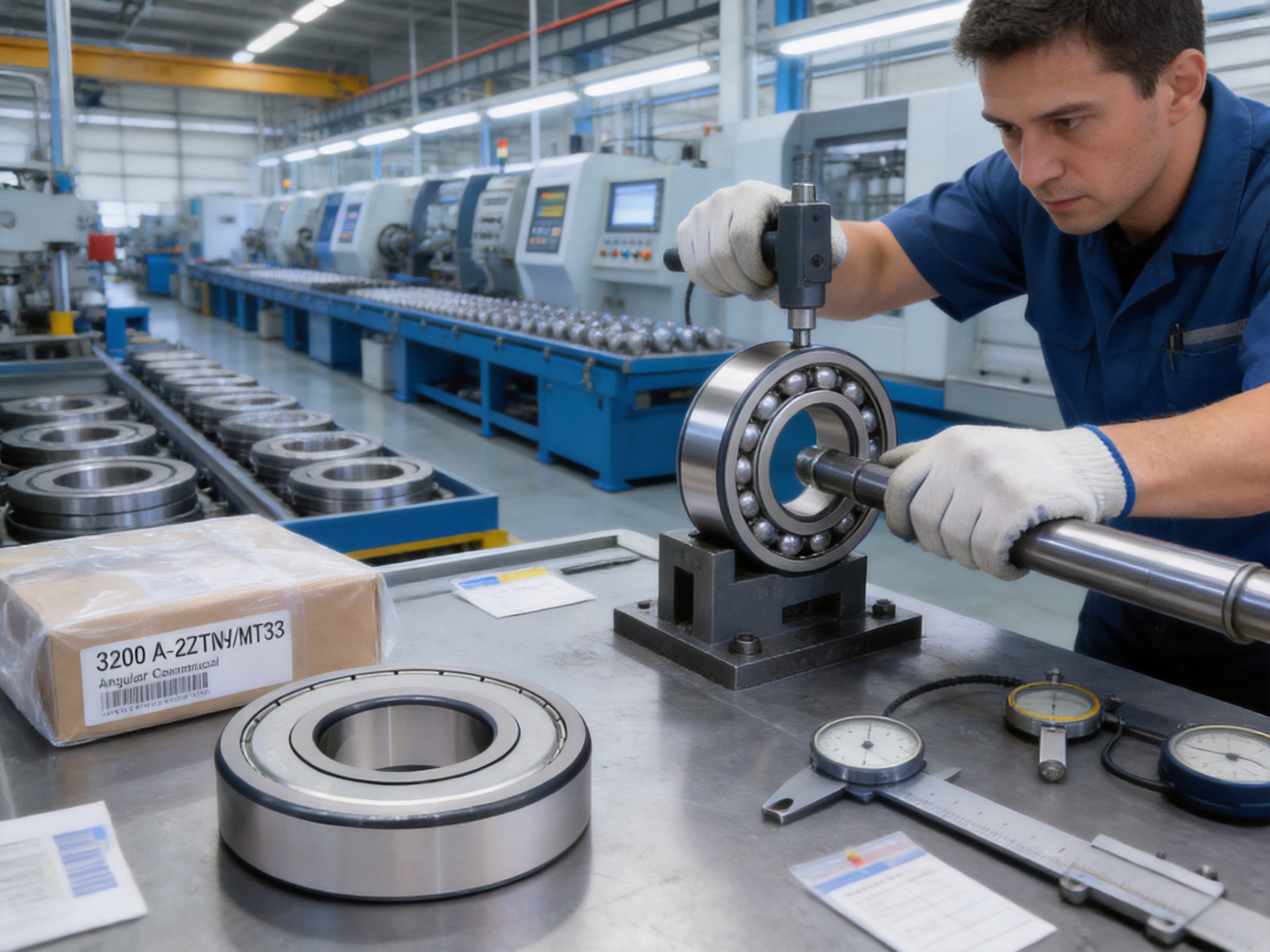
The quality of a bearing depends not only on its nominal dimensions but also on the consistency of the material, heat treatment, raceway geometry, surface finish, cleanliness, assembly accuracy, lubrication, and inspection process. UKL Bearing Manufacturing Co., Ltd. integrates research and development, production, and international distribution to support these requirements.
The company operates as a manufacturer and trader with OEM and ODM export experience. Its reported production capacity is approximately 10,000 to 50,000 units per month, supported by multiple production lines. This capacity allows the company to serve both recurring industrial programs and customized requirements while maintaining a structured production flow.
Forging creates the basic ring blank while helping develop a suitable material structure for subsequent machining and heat treatment. Controlled forging can improve material utilization and provide a consistent starting geometry. Attention to billet quality, heating temperature, deformation control, and cooling is important because defects introduced at this stage can affect later bearing performance.
For OEM programs, raw material traceability is particularly important. Material certificates, heat numbers, incoming inspection, and process records help connect finished bearings with their original material batch. This supports quality investigations and provides greater confidence for customers using bearings in safety-critical or continuously operating equipment.
Turning operations establish the primary ring dimensions, reference faces, bore, outside diameter, and initial raceway form. Consistent turning reduces the machining allowance variation that later grinding operations must remove. Stable fixtures and controlled cutting parameters help maintain concentricity and roundness.
The bearing’s performance is affected by the relationship between its bore, outside diameter, width, and raceway geometry. Dimensional control therefore cannot rely only on final inspection of a few visible dimensions. Process capability monitoring and in-process measurement help identify drift before it produces a large batch of nonconforming parts.
Bearing rings must combine hardness, fatigue resistance, dimensional stability, and toughness. Heat treatment is used to develop the required metallurgical properties. The cycle normally includes controlled heating, hardening, and tempering, with parameters selected according to the bearing steel and product requirements.
Uniformity is essential. Excessive distortion can increase grinding allowance, while inadequate hardness can reduce rolling-contact fatigue resistance. Process monitoring, furnace calibration, sample testing, hardness checks, and metallurgical verification are valuable tools for maintaining consistency across production batches.
Grinding determines the final accuracy of the bore, outside diameter, width, faces, and raceways. The raceway surface must provide a smooth and geometrically controlled path for the rolling elements. Surface waviness, roughness, form error, and roundness all influence noise, vibration, friction, and fatigue life.
Superfinishing can further improve the raceway surface by removing microscopic irregularities and creating a favorable texture for lubricant retention. A high-quality surface reduces local stress concentration and supports more stable elastohydrodynamic lubrication. For high-speed or low-noise applications, these details are especially important.
Assembly includes the controlled installation of balls, cage components, shields, and lubricant. The correct number and grade of balls must be matched with the bearing’s internal geometry. Cage installation must avoid deformation, while shield installation must provide consistent seating without damaging the ring or creating unnecessary friction.
For the 3200 A-2ZTN9/MT33 configuration, the supplied lubrication and shield arrangement should be maintained unless a technical review authorizes a change. Overfilling with grease can increase temperature and torque. Underfilling can reduce lubricant life and leave the raceway inadequately protected. Automated or metered grease application can improve consistency between units.
A professional bearing production system typically uses dimensional inspection, hardness testing, surface evaluation, noise and vibration testing, rotational torque checks, and visual inspection. Depending on the customer requirement, inspection may also include material analysis, metallographic examination, roundness measurement, raceway profile verification, and life testing.
Quality control is most effective when it is distributed across the production process rather than performed only at the end. Incoming material inspection, first-piece approval, in-process monitoring, final inspection, and traceability records create multiple opportunities to detect variation. This process-oriented approach is particularly important for OEM and ODM customers who require repeatable performance across large quantities.
Different applications may require changes to internal clearance, lubricant, cage material, shield design, dimensional tolerance, noise level, corrosion protection, or packaging. UKL’s integrated R&D and manufacturing structure supports technical discussions before production begins. Customers can provide shaft dimensions, housing details, load data, speed profiles, operating temperature, environmental conditions, and service-life expectations for evaluation.
Engineering cooperation is most effective when the bearing is treated as part of the complete mechanical system. The bearing cannot be selected correctly by bore diameter alone. The shaft fit, housing fit, shoulder dimensions, load distribution, thermal expansion, mounting sequence, and sealing arrangement all influence performance.
For customized orders, the manufacturer can evaluate the required production process, inspection plan, packaging method, and delivery schedule. OEM and ODM support may be useful for equipment manufacturers seeking a consistent private-label supply, a modified bearing configuration, or a bearing that matches an existing assembly drawing.
International customers may also benefit from multilingual technical communication, installation guidance, and after-sales support. Export experience across Europe, Asia, Africa, Russia, North America, and other markets requires attention to documentation, packaging, batch identification, and customer-specific quality requirements.
Before installation, confirm the bearing designation, dimensions, shield condition, packaging integrity, and visible cleanliness. Do not install a bearing if it has been dropped, exposed to excessive humidity, or contaminated by dust or metal particles. Keep the bearing in its original package until immediately before installation.
The shaft and housing should be checked for burrs, corrosion, incorrect chamfers, excessive roughness, and dimensional damage. The bearing seat must provide the correct fit for the applied rotating load. An incorrect fit may cause ring creep, fretting, excessive internal clearance reduction, or difficult installation.
When pressing the bearing onto a shaft, apply force only to the inner ring. When pressing the bearing into a housing, apply force only to the outer ring. If both rings require an interference fit, use a tool that applies force to both rings simultaneously. Never transmit installation force through the balls and raceways.
For tight fits, controlled induction heating or another approved heating method may be used. Avoid open flames and uncontrolled heating. Excessive temperature can damage lubricant, shields, cage material, or bearing steel. After installation, ensure the bearing is fully seated against the shoulder and that the shaft rotates smoothly.
Do not wash out the factory grease unless the application specification requires a different lubricant and the procedure has been technically approved. If relubrication is necessary, use a compatible grease in the correct quantity. Mixing incompatible greases can cause softening, hardening, oil separation, or loss of lubrication performance.
Bearing life is influenced by more than the catalog load rating. Cleanliness is one of the most important factors. Fine particles can create dents in the raceways, and these dents may become stress concentrations that lead to fatigue. Effective seals, clean assembly practices, filtered lubricant, and protected storage can significantly improve reliability.
Misalignment can produce uneven load distribution across the rolling elements. The bearing should therefore be mounted in accurately machined seats, and the shaft and housing should be checked for angular alignment. Excessive housing deformation may also distort the outer ring and increase running torque.
Temperature should be monitored in applications involving high speed, continuous operation, or limited heat dissipation. A gradual increase in temperature may indicate excessive grease, insufficient clearance, overloading, misalignment, shield damage, or an unsuitable fit. Noise and vibration monitoring can provide additional early warning of raceway damage, contamination, cage problems, or mounting defects.
Where the bearing is used in a sealed industrial assembly, periodic maintenance may focus on temperature, vibration, noise, shaft movement, and lubricant leakage. In serviceable systems, relubrication intervals should be established using speed, temperature, load, grease type, and contamination conditions rather than a universal time interval.
When evaluating the 3200 A-2ZTN9/MT33, engineers should confirm the following points:
First, verify that the 10 mm bore, 30 mm outside diameter, and 14 mm width fit the shaft and housing. Check shoulder diameters, fillet radii, retaining rings, spacers, and adjacent components.
Second, calculate the equivalent dynamic bearing load using the actual radial and axial forces. Include belt tension, gear forces, shock, acceleration, and any external moment converted into bearing reactions.
Third, check the static safety factor for stationary loads, impact, transport, emergency stops, and peak operating conditions.
Fourth, compare the actual operating speed with the listed reference and limiting speeds. Consider temperature, lubrication, axial load, and acceleration when establishing the working speed.
Fifth, confirm whether the 2Z shielded configuration provides sufficient environmental protection. If water, abrasive dust, or chemical exposure is expected, consider whether a sealed or specially protected design is required.
Sixth, confirm lubricant compatibility with the application. Consider process fluids, gearbox oils, cleaning agents, operating temperature, and storage conditions.
Seventh, assess shaft and housing rigidity. A high-capacity bearing cannot compensate for a flexible housing, inadequate shoulder, poor fit, or excessive shaft deflection.
Eighth, determine the required precision, noise level, vibration grade, clearance, and inspection documentation before placing an OEM order.
It is a double row angular contact ball bearing with shields on both sides. It is designed to support radial loads, axial loads in both directions, and overturning moments in a compact assembly.
The listed dimensions are 10 mm bore diameter, 30 mm outside diameter, and 14 mm width. The approximate mass is 0.051 kg.
The 2Z suffix indicates shields on both sides of the bearing. These shields help retain grease and protect the internal rolling elements from ordinary external contamination while generally allowing high-speed operation with low contact friction.
TN9 identifies a molded polyamide cage configuration commonly used in this bearing family. The cage separates and guides the balls to support smooth rolling operation.
Yes. The double row angular contact arrangement is designed to accommodate axial loads acting in both directions. The permissible load depends on the applied radial load, speed, lubrication, internal geometry, and operating conditions.
It can serve as a compact alternative in many applications, especially where bidirectional axial location and moment resistance are required. However, it should not be treated as an automatic replacement. The designer must compare load capacity, stiffness, preload, clearance, speed, life, and mounting requirements.
The supplied data lists a reference speed of 23,400 r/min and a limiting speed of 21,600 r/min. Actual operating speed must be confirmed through a thermal and application review, especially when the bearing is heavily loaded or operates at elevated temperature.
Common applications include automotive front wheel hubs, oil pumps, Roots blowers, air compressors, transmissions, gearboxes, machine tool mechanisms, robotics, and compact automation equipment.
It may be suitable for a gearbox when the load, speed, temperature, lubricant, and contamination conditions are compatible. The designer must confirm whether the factory grease and shielded configuration are suitable for exposure to the gearbox oil.
Use clean tools and apply mounting force only to the ring with the interference fit. Do not strike the bearing directly or transfer installation force through the balls. Confirm full seating, correct alignment, and smooth rotation after installation.
UKL provides OEM and ODM support and can evaluate requirements involving dimensions, lubrication, cage design, sealing, materials, packaging, inspection, and production quantities. Customers should provide complete application information for technical assessment.
Useful information includes the bearing designation, quantity, operating speed, radial and axial loads, temperature range, environment, lubrication method, shaft and housing dimensions, precision requirements, packaging requirements, and delivery destination.
The 3200 A-2ZTN9/MT33 double row angular contact ball bearing is a compact solution for machinery that requires more than simple radial support. Its two-row angular contact geometry enables radial load capacity, bidirectional axial location, high rigidity, and resistance to overturning moments within a relatively narrow axial envelope. The shielded construction supports grease retention and protection in suitable operating environments, while the small dimensions and low mass make it attractive for compact, high-speed mechanisms.
Its advantages over a single row radial bearing are most apparent when axial forces reverse or when shaft deflection and angular movement must be controlled. Its advantages over two separate single row angular contact bearings include reduced axial space, fewer components, simplified assembly, and an integrated load path. Nevertheless, final selection should always be based on a complete review of load, speed, temperature, lubrication, contamination, mounting, and service-life requirements.
UKL Bearing Manufacturing Co., Ltd. supports this product through integrated research and development, forging, turning, heat treatment, grinding, assembly, packaging, and international distribution capabilities. Its production structure, reported monthly capacity, OEM and ODM experience, and technical service approach provide a foundation for both standard supply and customized bearing programs.
For equipment manufacturers, distributors, and engineering teams, the 3200 A-2ZTN9/MT33 offers a practical combination of compact dimensions, combined-load capability, and mechanical rigidity. When correctly selected, installed, lubricated, and maintained, it can contribute to stable shaft positioning, reduced assembly complexity, and dependable performance in demanding industrial equipment.
1. ISO 15, Rolling Bearings—Radial Bearings—Boundary Dimensions, International Organization for Standardization.
2. ISO 281, Rolling Bearings—Dynamic Load Ratings and Rating Life, International Organization for Standardization.
3. ISO 76, Rolling Bearings—Static Load Ratings, International Organization for Standardization.
4. ISO 15257, Rolling Bearings—Methods for Measuring Vibration, International Organization for Standardization.
5. General engineering principles for angular contact ball bearing selection, mounting, lubrication, and maintenance.
6. Manufacturer-supplied dimensional and performance data for the 3200 A-2ZTN9/MT33 double row angular contact ball bearing.
7. Manufacturer technical information concerning bearing production, OEM and ODM services, inspection, packaging, and international distribution.
Product Categories
Contact Us

Jane@ukl-bearing.com
Jenny@ukl-bearing.com
Andy@ukl-bearing.com
Ivy@ukl-bearing.com

+86-510- 88763239
+86-15371057968

No.1 Hehuan Road, Hudai Town, Binhu District, Wuxi City.
Ready to Begin?
Get in Touch

Now!
UKL BEARING
 English
 Español
 русский