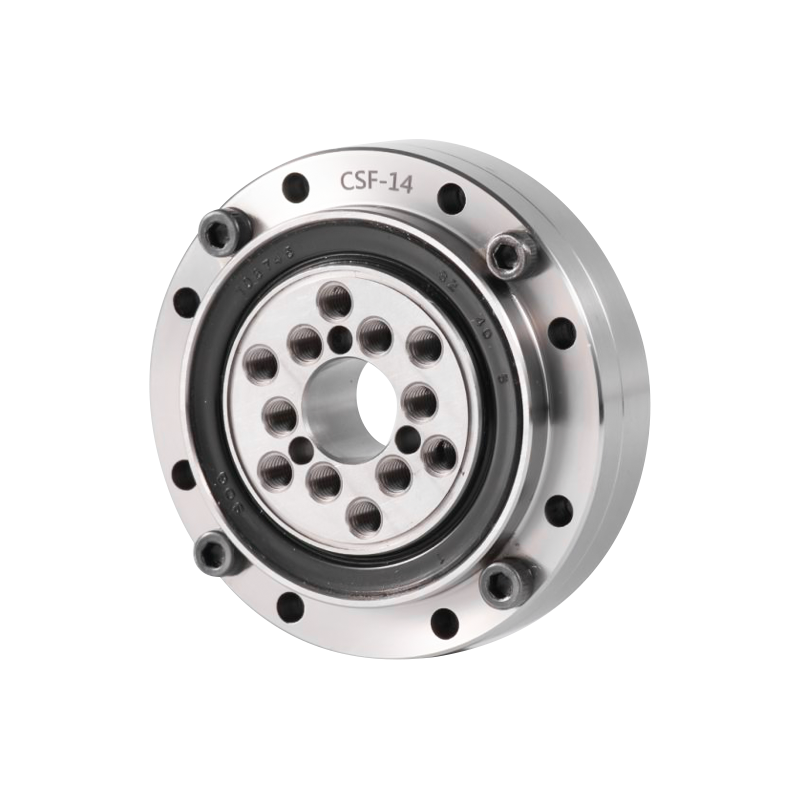
Content
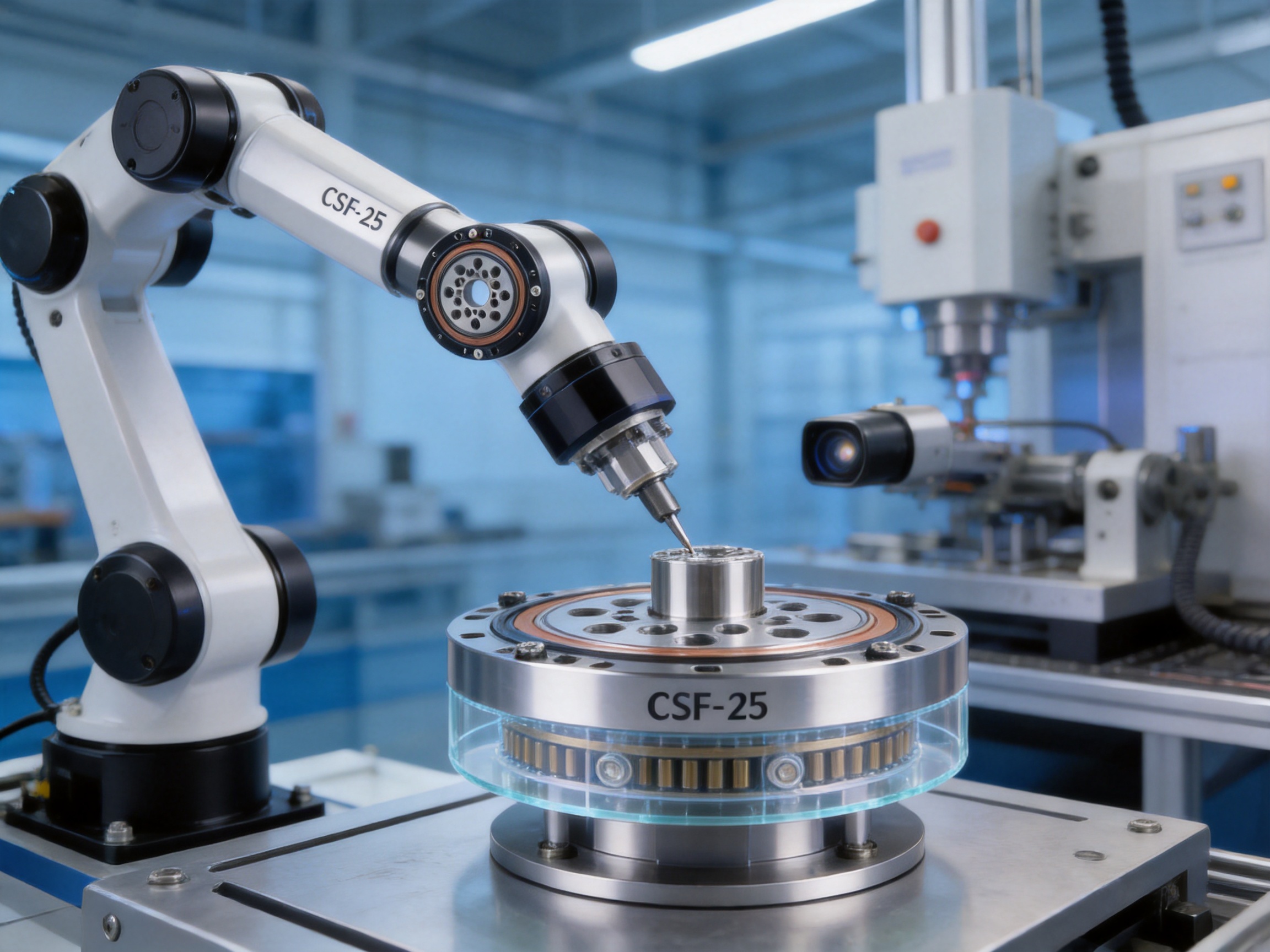
Harmonic reducers are among the most demanding transmission systems used in modern robotics, machine tools, aerospace equipment, and intelligent automation. Their compact architecture delivers high reduction ratios, low backlash, excellent positioning accuracy, and strong torque transmission in a relatively small envelope. However, the performance of the complete reducer depends heavily on the precision, rigidity, reliability, and deformation behavior of its bearings.
Precision harmonic reducer bearings are designed specifically for the operating conditions found inside harmonic drive systems. They support the rigid wheel, flexure, and harmonic generator while maintaining controlled rolling contact, stable preload, and accurate rotation. In many applications, the bearing is not simply a standard catalog component. It is a precision-engineered part that must match the reducer’s geometry, load path, mounting arrangement, and required motion accuracy.
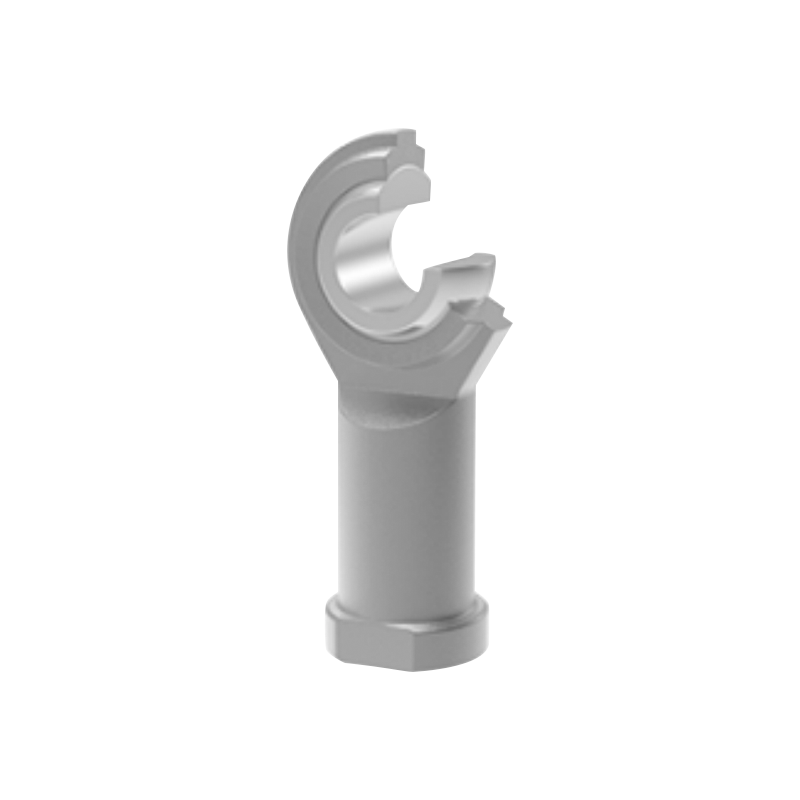
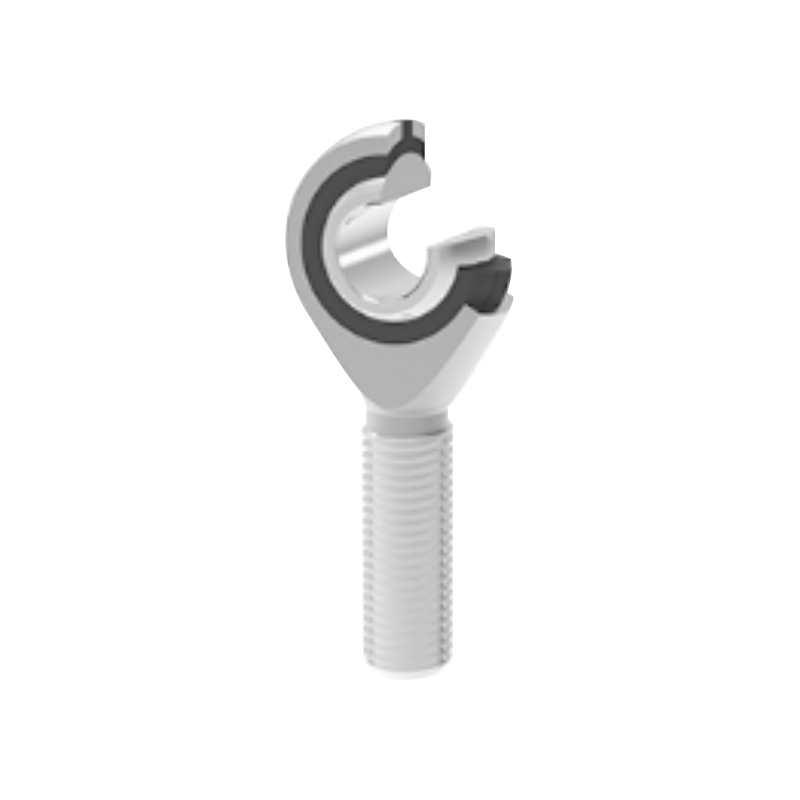
UKL Bearing Manufacturing Co., Ltd. supplies precision harmonic reducer bearings for robotics, automation equipment, machine tools, aerospace mechanisms, and other high-performance applications. The company integrates product development, manufacturing, assembly, quality control, and international distribution. Its product range includes cross roller bearings, angular contact ball bearings, spherical roller bearings, cylindrical roller bearings, tapered roller bearings, mounted bearings, rod end bearings, Nilos rings, and other customized bearing solutions.
This article explains the structure and working requirements of harmonic reducer bearings, examines the advantages of precision cross roller bearing designs, reviews the available CSF(G) series dimensional range, and describes the manufacturing capabilities that support consistent performance in demanding industrial environments.
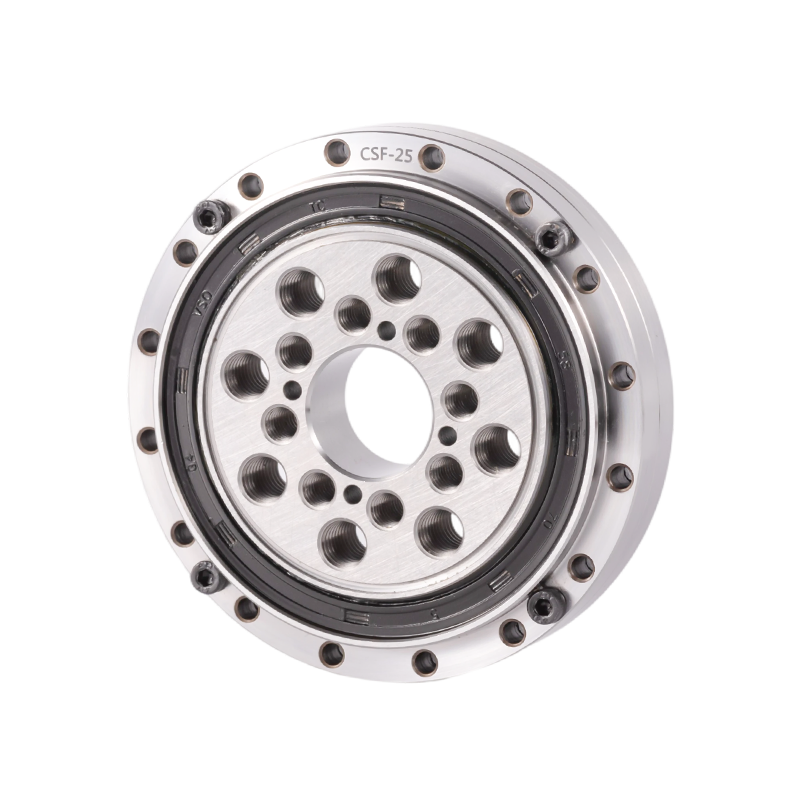
Precision Harmonic Reducer Bearing
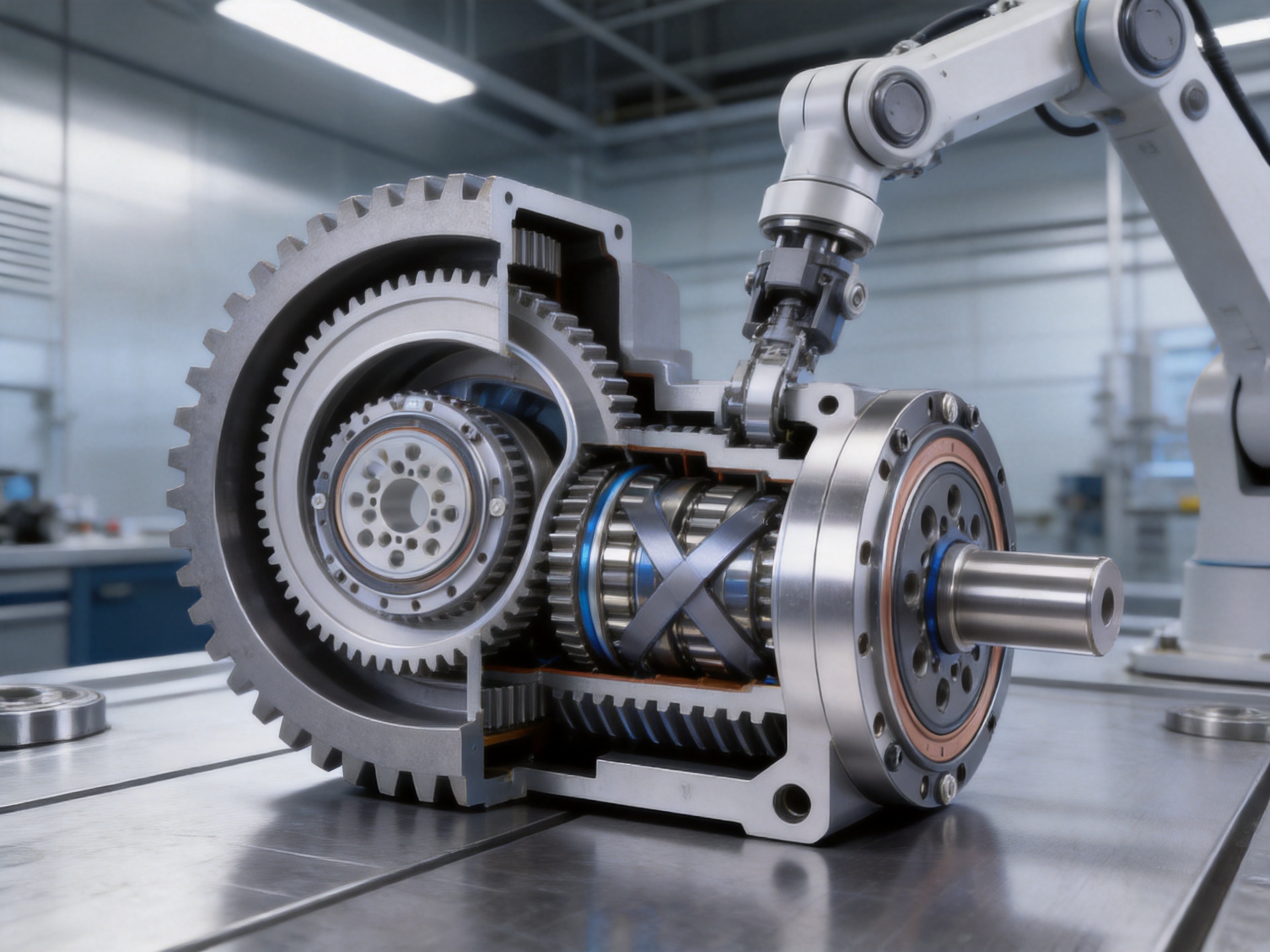
A harmonic reducer generally consists of three primary transmission components: a harmonic generator, a flexure, and a rigid wheel. The system also uses a rigid bearing, commonly a crossed roller bearing, and a flexible bearing, often a thin-walled deep groove ball bearing.
The harmonic generator normally includes an elliptical cam. The inner bore of the flexible bearing is fitted over the cam. As the cam rotates, the flexible bearing is forced into an elliptical shape. The outer ring of the flexible bearing then engages with the inner surface of the flexure.
The flexure is a thin-walled, elastic component with external teeth. Its teeth mesh with the internal teeth of the rigid wheel. Because the rigid wheel contains more teeth than the flexure, the two components engage at the major axis of the ellipse and separate at the minor axis. This controlled engagement creates the reduction effect.
The bottom or output section of the flexure is fixed to the output end of the reducer. The rigid bearing is installed at the reducer output end and provides the rotational support required for connection to an external mechanism. The bearing must accommodate the radial, axial, and overturning loads produced by the robot arm, actuator, or machine structure connected to the reducer.
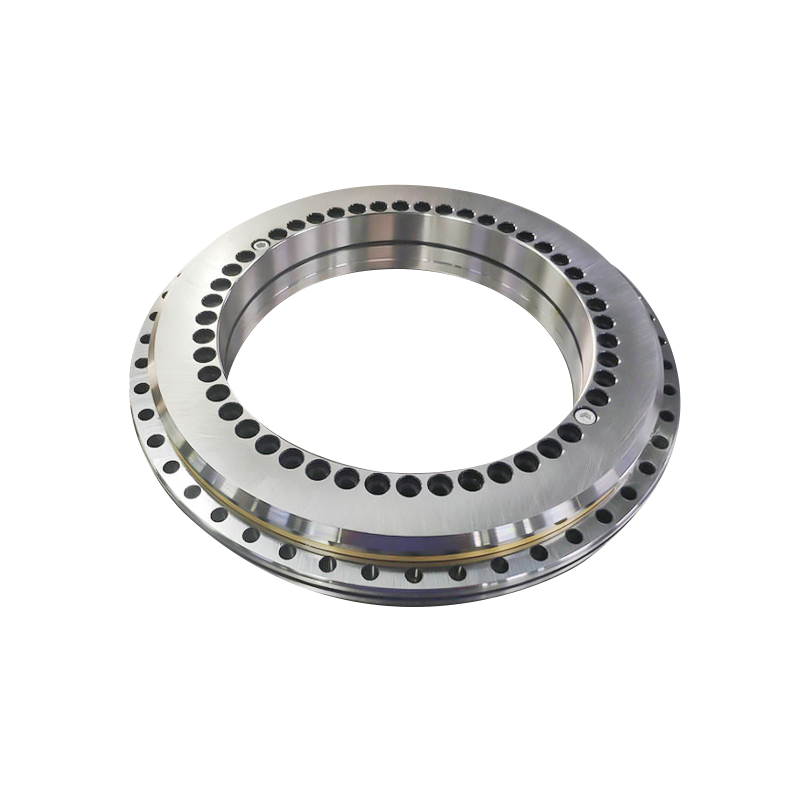
In this arrangement, the rigid bearing is often a crossed roller bearing because crossed rollers can support combined loads while maintaining high rotational accuracy. The rollers are arranged alternately at right angles, allowing the bearing to resist radial loads, axial loads, and moment loads within a compact cross section.
The flexible bearing has a different primary function. It must tolerate repeated elastic deformation as the harmonic generator rotates. For this bearing, maximum allowable radial deformation, fatigue resistance, friction, and service life are especially important. The rigid bearing, by comparison, is primarily evaluated for rigidity, reliability, rotational accuracy, preload stability, and load-bearing capacity.
Harmonic reducers are used where small positional errors can affect the quality, safety, or productivity of an entire machine. A robot joint may need to repeat a programmed position thousands of times. A machine tool spindle or rotary axis may need to maintain stable alignment while carrying cutting forces. An aerospace actuator may need to operate reliably under vibration, temperature changes, and variable loads.
Any error in the bearing can influence the reducer’s total performance. Radial runout may cause the output flange to move away from its intended axis. Axial runout may affect the position of a connected component. Insufficient rigidity can produce elastic displacement under load. Excessive internal clearance can reduce positioning accuracy, while excessive preload can increase friction, heat generation, and torque requirements.
Bearing geometry must therefore be controlled at several levels. The raceways must have accurate profiles and surface finishes. Roller diameter and length must be consistent. The crossed roller arrangement must be assembled correctly. Mounting holes, flange dimensions, and reference surfaces must remain within the required tolerances. Lubrication must be properly distributed, and sealing or protective arrangements must be compatible with the application environment.
For a harmonic reducer manufacturer, bearing selection cannot be separated from reducer design. The bearing’s outer diameter, inner diameter, width, mounting pattern, preload, and load capacity must correspond to the rigid wheel, flexure, output flange, and housing. A bearing that is dimensionally suitable but poorly matched in stiffness or preload may not deliver the expected system performance.
A crossed roller bearing uses cylindrical rollers arranged alternately at approximately 90-degree orientations. One group of rollers supports loads in one direction, while the alternating group supports loads in the perpendicular direction. Because both roller groups operate in a shared raceway system, the bearing can handle combined radial and axial loads.
The design also provides strong resistance to overturning moments. This is particularly valuable in robotic joints, where the output flange may carry a long arm, gripper, tool, payload, or offset load. The resulting moment can be much greater than the direct radial load. A compact crossed roller bearing can support this moment while maintaining a low profile and a relatively large hollow or open center, depending on the design.
Compared with a conventional deep groove ball bearing, a crossed roller bearing generally provides higher rigidity and improved moment-load resistance in a similar installation space. Compared with a pair of separated angular contact bearings, it can reduce the number of components, simplify the housing structure, and help reduce axial installation space.
These advantages make crossed roller bearings well suited to harmonic reducer output stages. The bearing can support the external connection while the reducer’s internal components transmit torque. Properly selected preload increases structural stiffness and helps control movement between the inner and outer rings.
Preload is normally applied before shipment for rigid harmonic reducer bearings. The purpose is to reduce internal clearance and improve rigidity, rotational accuracy, and resistance to vibration. Preload must be carefully controlled. If it is too low, the bearing may experience unwanted movement or reduced stiffness. If it is too high, starting torque, operating temperature, and wear may increase.
Rigidity is one of the most important characteristics of a harmonic reducer bearing. When a robot joint changes direction or holds a load at a fixed position, the bearing must minimize elastic displacement. High rigidity helps preserve the relationship between the reducer output, the encoder, and the driven mechanism.
The crossed roller structure distributes loads through multiple rollers and provides strong resistance to radial, axial, and moment forces. A correctly designed and preloaded bearing can help reduce output deflection and improve the apparent stiffness of the entire reducer assembly.
Rotational accuracy is affected by raceway geometry, roller consistency, ring roundness, mounting surfaces, preload, and assembly quality. Precision harmonic reducer bearings are manufactured to support stable rotation with controlled runout and low variation.
High rotational accuracy is essential in robot joints, precision indexing equipment, semiconductor machinery, optical systems, and machine tools. It helps reduce trajectory deviation, improves repeatability, and supports smoother motion during low-speed operation.
A harmonic reducer output bearing may experience radial loads, axial loads, and moment loads at the same time. A bearing designed only for radial loading may not provide sufficient stability when an external arm or offset payload is attached.
Crossed roller bearings are designed for combined loading. Their perpendicular roller arrangement allows the bearing to resist forces in multiple directions without requiring several separate bearing sets. This can simplify the reducer structure and improve the relationship between load capacity and installation space.
Robotic joints and compact actuators often have strict dimensional limitations. The bearing must fit inside a small housing while providing a sufficiently large support diameter and adequate stiffness. The CSF(G) series is available in multiple sizes, allowing designers to select a bearing according to the required reducer frame size and mounting arrangement.
A compact bearing can contribute to a smaller actuator envelope, lower joint mass, and improved robot dynamics. Reduced mass is especially beneficial for articulated robots because lighter distal joints decrease the load on upstream motors and reducers.
Stable preload supports consistent rigidity and smooth operation. In precision harmonic reducer applications, preload should remain controlled throughout assembly, operation, and service life. Changes in preload may be caused by dimensional variation, mounting distortion, temperature changes, contamination, or wear.
Consistent manufacturing and careful assembly help reduce these risks. UKL’s manufacturing system covers forging, turning, heat treatment, grinding, assembly, and packaging. Integrating these stages enables tighter process coordination and helps maintain consistent component quality from raw material preparation through final shipment.
Harmonic reducer bearings are used in equipment that may operate continuously, intermittently, or through frequent acceleration and deceleration cycles. The bearing must withstand repeated changes in speed and load without excessive friction, vibration, or deterioration.
Reliable operation depends on correct design, material quality, heat treatment, surface finishing, lubrication, sealing, mounting, and maintenance. A bearing supplier with experience in OEM and ODM projects can help adapt these factors to the customer’s reducer design rather than treating every application as a standard replacement part.
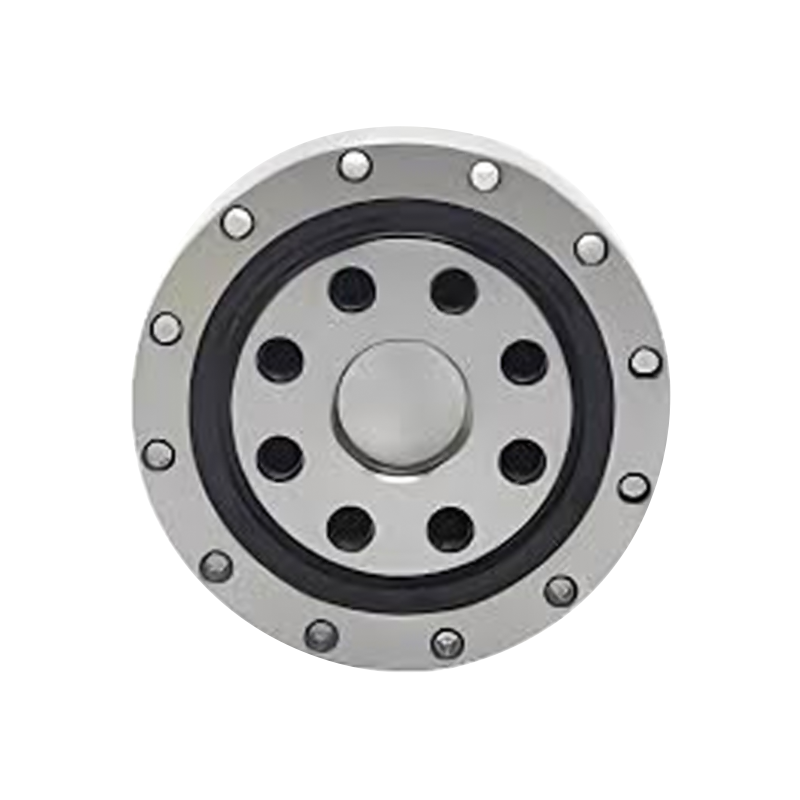
The supplied CSF(G) series dimensional schedule covers bearing types from CSF(G)-14 through CSF(G)-65. These models are intended for compact to medium-size harmonic reducer configurations. The dimensions and mounting details should be confirmed against the final technical drawing before production or installation, particularly where the source schedule lists alternative bore sizes or multiple mounting specifications.
| Bearing Type | D (mm) | d (mm) | C (mm) | H (mm) | B (mm) | Installation Data | Weight (kg) |
|---|---|---|---|---|---|---|---|
| CSF(G)-14 | 55 | 11 | 16 | 16.5 | 13.5 | dm 49; 8-φ3.5; dn 23; 6-M4; dl 17; 6-M4 | 0.15 |
| CSF(G)-17 | 62 | 10 | 16 | 16.5 | 13.5 | dm 56; 10-φ3.5; dn 27; 6-M5; dl 19; 6-M5 | 0.24 |
| CSF(G)-20 | 70 | 14 | 16 | 16.5 | 13.5 | dm 64; 12-φ3.5; dn 32; 8-M6; dl 24; 8-M5 | 0.30 |
| CSF(G)-25 | 85 | 20 | 18 | 18.5 | 16.5 | dm 79; 16-φ3.5; dn 42; 8-M8; dl 30; 8-M6 | 0.45 |
| CSF(G)-32 | 112 | 26 | 21.5 | 22.5 | 19 | dm 104; 16-φ4.5; dn 55; 8-M10; dl 40; 8-M8 | 0.90 |
| CSF(G)-40 | 126 | 24/32 | 22.5 | 24 | 21.5 | dm 117; 20-φ5; dn 68; 8-M10; dl 50; 8-M10 | 1.30 |
| CSF(G)-50 | 157 | 32/40 | 30 | 31 | 28 | dm 147; 16-φ5.5; dn 84; 8-M14; dl 60; 8-M14 | 2.80 |
| CSF(G)-65 | 210 | 44/52 | 37 | 39 | 35 | dm 198; 20-φ6.5; dn 110; 8-M16; dl 80; 8-M16 | 7.90 |
The table presents the dimensional information supplied for the product range. D and d represent the listed primary outer and inner dimensions. C, H, and B are the listed dimensional values in the source schedule. The installation data includes pitch-circle or reference dimensions and hole specifications as supplied. Because naming conventions can vary between manufacturers, the exact meaning of dm, dn, dl, and each mounting reference should be verified with the approved product drawing.
The series includes very compact models such as CSF(G)-14 and CSF(G)-17, as well as larger CSF(G)-50 and CSF(G)-65 models for applications requiring greater load support and a larger connection interface. The range enables equipment designers to maintain a consistent bearing concept across different robot joint sizes or reducer platforms.
Bearing performance begins with material quality. Bearing rings must have the appropriate chemical composition, cleanliness, toughness, and hardenability. Forging can help produce a sound material structure and improve the utilization of raw material. Proper forging control reduces the risk of internal defects and supports the development of a consistent grain structure.
At UKL, manufacturing activities include forging and subsequent machining. Process control at this stage contributes to dimensional stability during later heat treatment and grinding. For high-precision bearings, the quality of the initial ring blank has a direct effect on final roundness, raceway geometry, and fatigue resistance.
Turning creates the basic ring profile, reference surfaces, mounting features, and machining allowances required for heat treatment and finishing. Accurate turning is important because it establishes the relationship between the bearing raceway, bore, outside diameter, end faces, and mounting holes.
For harmonic reducer bearings, mounting accuracy is particularly important. The bearing may be installed directly into a precision reducer housing or attached to an output flange. Errors in the mounting face or hole pattern can produce distortion after installation, even when the bearing itself has been manufactured accurately.
Heat treatment gives bearing rings the hardness, strength, and wear resistance required for rolling contact. The process must be controlled carefully to balance hardness with toughness and dimensional stability. Excessive distortion can increase the amount of material that must be removed during grinding or can reduce the available tolerance margin.
Consistent heat treatment supports predictable service performance. It helps the raceways resist plastic deformation, surface fatigue, and wear under repeated loading. For harmonic reducer applications, the heat-treatment process must also support long-term preload stability and accurate raceway geometry.
Grinding is one of the most important stages in precision bearing production. It improves the size, roundness, surface finish, raceway profile, and parallelism of the rings. High-quality grinding helps reduce friction, vibration, noise, and localized contact stress.
The raceway surface must provide smooth and stable rolling contact. Surface irregularities can create vibration, accelerate lubricant degradation, and increase the risk of premature fatigue. Precision finishing is therefore essential for robotic joints and other applications where low-speed smoothness and positional repeatability are important.
After the rings and rolling elements have been manufactured and inspected, the bearing is assembled under controlled conditions. Crossed roller bearings require correct roller orientation and careful placement of spacers or retainers, depending on the design. The assembly process must ensure that the rollers are properly seated and that the load is distributed consistently.
Preload is then controlled according to the intended application. The objective is to achieve the required stiffness and rotational accuracy without creating excessive friction. A qualified assembly process is especially important for harmonic reducer bearings because preload directly affects reducer torque, output deflection, temperature rise, and service life.
Precision bearings must be protected from contamination, corrosion, impact, and humidity during storage and transportation. Packaging should maintain the condition of the finished bearing and prevent unnecessary movement inside the package.
Correct identification is also important for OEM projects. Model number, size, preload class, lubrication specification, inspection status, and customer reference should be clearly managed. Traceable packaging and documentation help the customer organize incoming inspection and production-line installation.
Harmonic reducer bearings offer several advantages over conventional bearing arrangements when the application requires high stiffness, compact size, and combined-load capability.
First, the crossed roller design can support axial and radial loads simultaneously. A conventional radial bearing may require an additional axial bearing or a separate moment-supporting arrangement. This increases component count and can make the housing more complicated.
Second, crossed roller bearings can provide high moment rigidity in a short axial space. This is valuable when the external load is offset from the bearing center. In a robot joint, the bearing may need to resist the bending moment generated by an arm or payload without allowing excessive angular displacement.
Third, precision preload can improve the stiffness and repeatability of the output structure. A loose bearing arrangement may permit microscopic movement that becomes visible as backlash, vibration, or positional deviation. Proper preload helps control this movement.
Fourth, a standardized dimensional series can simplify equipment development. Designers can select a suitable model from a range of sizes rather than creating a completely new bearing architecture for every reducer. At the same time, custom production remains possible when the standard dimensions, preload, lubrication, or mounting pattern do not match the customer’s requirements.
Finally, a specialist manufacturer can coordinate bearing design with the customer’s application. The correct solution may involve more than choosing a diameter. It may require a review of load direction, overturning moment, speed, duty cycle, temperature, lubrication, housing material, mounting tolerance, sealing, and maintenance conditions.
Industrial robots use harmonic reducers in joints that require high reduction ratios and accurate positioning. Precision bearings support the output structure and help the robot maintain stable movement under payload and acceleration loads.
Welding robots, painting robots, assembly robots, palletizing systems, and material-handling robots can all benefit from high-rigidity bearing arrangements. The bearing must operate smoothly across repeated cycles and help maintain accuracy throughout the equipment’s service life.
Collaborative robots are designed to work near people and often emphasize compact dimensions, low weight, low noise, and sensitive force control. A precision harmonic reducer bearing can contribute to a compact joint while supporting the external load and resisting moment forces.
Stable friction and controlled preload are important in collaborative systems because irregular torque can affect force sensing and motion smoothness. The bearing and reducer should therefore be evaluated as a complete actuator assembly.
Machine tools require stable positioning, low vibration, and high structural rigidity. Harmonic drive systems may be used in rotary axes, tool changers, positioning units, inspection mechanisms, and auxiliary automation modules.
In these applications, bearing runout, thermal behavior, and mounting accuracy can affect machining quality. Precision crossed roller bearings can provide a compact support solution for rotary tables and indexing mechanisms where combined loading is present.
Aerospace equipment places strong demands on weight, reliability, size, and environmental performance. Actuators, antenna positioning systems, optical mechanisms, and satellite equipment may use precision reduction systems requiring carefully controlled bearings.
Application-specific material, lubrication, cleanliness, inspection, and qualification requirements should be reviewed for each aerospace project. The general bearing concept is suitable for demanding motion systems, but the final specification must be established according to the aircraft, spacecraft, or aerospace mechanism standard.
Automated inspection machines, semiconductor equipment, optical positioning systems, packaging equipment, and precision assembly stations require repeatable motion. These applications may operate at moderate speeds but demand excellent stability and low runout.
A precision harmonic reducer bearing can help create a compact rotary module with high load capacity and accurate positioning. This is useful where installation space is limited and the mechanism must carry a tool, sensor, camera, gripper, or workpiece.
Selection should begin with a complete load analysis. The designer should identify radial load, axial load, overturning moment, operating speed, acceleration, deceleration, duty cycle, and expected service life. The maximum load may occur during emergency stops or rapid direction changes rather than during normal steady-state operation.
For robotic applications, payload position is particularly important. A small payload located far from the bearing center can produce a substantial moment. The bearing should be selected according to the complete external load path rather than payload mass alone.
The housing and shaft or flange must provide suitable roundness, flatness, coaxiality, and surface finish. Improper mounting can distort the bearing rings and change the internal preload. The mounting structure should be sufficiently rigid to support the bearing without excessive deformation.
Installation holes and pitch-circle dimensions should be checked against the approved drawing. Fastener torque should be controlled, and the mounting sequence should be designed to avoid uneven clamping forces.
Lubrication reduces friction, protects rolling contacts, and helps control heat generation. The lubricant should be selected according to speed, load, temperature, environment, sealing arrangement, and maintenance interval.
Too little lubricant can cause excessive wear and temperature rise. Too much lubricant can increase churning resistance and torque. Grease compatibility should also be checked when the bearing is installed in an existing reducer containing other lubricated components.
Operating temperature affects lubricant viscosity, ring dimensions, preload, and service life. Dust, moisture, chemicals, vibration, and cleaning fluids may also affect bearing performance. Where the application environment is harsh, sealing, protective covers, special coatings, corrosion-resistant materials, or adjusted maintenance procedures may be required.
Service-life calculations should consider the actual load spectrum rather than a single nominal load. Frequent reversals, shock loading, oscillation, micro-motion, and long periods at low speed can produce conditions different from continuous rotation.
Maintenance planning should include lubrication intervals, inspection of temperature and noise, monitoring of torque, and checks for abnormal vibration or output play. Early detection can prevent damage to the bearing and connected reducer components.
Harmonic reducer manufacturers often require dimensions or performance characteristics that differ from standard catalog products. The bearing may need a special bore, outer diameter, width, mounting hole pattern, preload, lubricant, sealing arrangement, material grade, or inspection requirement.
UKL provides OEM and ODM support for customers requiring customized bearing solutions. Its engineering process can begin with a drawing, sample, reducer assembly, load specification, or application description. Technical evaluation may include dimensional review, load analysis, material selection, manufacturing feasibility, tolerance planning, and inspection requirements.
Customization is not limited to changing one dimension. A successful OEM bearing project must preserve the relationship between raceway geometry, roller arrangement, mounting surfaces, preload, and operating conditions. Changes to the housing or reducer assembly may require a corresponding adjustment to the bearing design.
The company’s product development capabilities include high-precision cross roller bearings, dual-direction thrust angular contact ball bearings, and other specialized products used in CNC machines, robotics, and intelligent automation systems. This broader product knowledge can help customers coordinate different bearing types within one machine.
UKL Bearing Manufacturing Co., Ltd. was established in 2020 and operates as an integrated manufacturer and trader with OEM and ODM export experience. The company reports a workforce of approximately 201 to 500 employees and production capacity of 10,000 to 50,000 units per month.
Its manufacturing activities cover forging, turning, heat treatment, grinding, assembly, and packaging. This integrated structure supports process coordination and gives customers a single supply partner for design assistance, production, inspection, and shipment.
UKL serves customers in Europe, Asia, Africa, Russia, North America, and other markets. Its stated export destinations include the United States, Italy, Germany, Poland, South Africa, Egypt, and India. A multilingual service team provides technical response, installation guidance, and after-sales support for international customers.
The company also emphasizes digital production control, research and development, and continuous improvement. These capabilities are important for precision bearing production because consistent results depend on controlled processes rather than final inspection alone.
Environmental responsibility is incorporated into the company’s long-term operating approach. Material recycling, energy optimization, and environmentally responsible processes can reduce the impact associated with industrial production while supporting efficient resource use.
Quality assurance should cover raw materials, semi-finished rings, heat-treated components, precision-ground parts, rolling elements, assembly, and final packaging. Each stage contributes to the final bearing’s performance.
Typical inspection categories include dimensional accuracy, raceway geometry, roundness, surface finish, hardness, mounting-hole position, rotational torque, runout, preload, noise, vibration, and visual condition. The exact inspection plan should be matched to the product drawing and customer quality agreement.
For harmonic reducer bearings, preload and rotational accuracy deserve particular attention. These characteristics affect the stiffness, torque, temperature, and positioning behavior of the complete reducer. Inspection records should be retained according to the customer’s traceability requirements.
Incoming inspection at the customer’s facility may include identification verification, dimensional checks, visual inspection, rotation testing, mounting verification, and preload or torque confirmation. Proper storage before installation is also important. Bearings should remain sealed in their original packaging until they are ready for assembly.
Before installation, the housing, shaft, flange, fasteners, and bearing should be cleaned and inspected. Burrs, chips, corrosion, paint, and foreign particles can cause mounting errors or raceway contamination.
The bearing should be installed using the specified mounting surfaces and tools. Impacting the rings or applying force through the rolling elements can damage the raceways. Fasteners should be tightened progressively in a suitable sequence to prevent distortion.
After installation, the bearing should be rotated by hand or at low speed to check for abnormal resistance, noise, or uneven motion. If the bearing is part of a harmonic reducer, the entire reducer should be checked for smooth operation before full-load testing.
Lubricant should be applied according to the technical specification. The bearing should not be operated at high speed immediately after excessive grease application. A controlled running-in procedure can help distribute lubricant and stabilize operating torque.
A crossed roller bearing is commonly used because it can support radial loads, axial loads, and overturning moments in a compact structure. Its high rigidity and rotational accuracy make it suitable for the output end of a harmonic reducer.
The rigid bearing supports the reducer output and external loads. Its key requirements include rigidity, reliability, preload stability, and rotational accuracy. The flexible bearing works with the elliptical harmonic generator and must tolerate repeated elastic deformation. Its maximum radial deformation and fatigue performance are especially important.
Preload reduces internal clearance and improves rigidity, rotational accuracy, and resistance to vibration. It must be controlled carefully because excessive preload can increase friction, heat, and operating torque.
OEM and ODM customization may be available for dimensions, mounting patterns, preload, lubrication, materials, and other specifications. The final feasibility should be confirmed using the customer’s drawing, load data, reducer structure, and production requirements.
Model selection depends on the required dimensions, radial and axial loads, overturning moment, speed, duty cycle, mounting arrangement, and expected service life. The dimensional table provides a starting point, but the final selection should be confirmed through technical evaluation.
The listed dimensions are useful for preliminary selection, but production should be based on an approved technical drawing. The source schedule includes several installation references and alternative bore values for some models, so the exact interpretation and tolerance must be confirmed before manufacture.
Typical industries include industrial robotics, collaborative robotics, machine tools, aerospace equipment, semiconductor machinery, optical systems, automated inspection, packaging equipment, and intelligent manufacturing.
A crossed roller bearing generally offers higher rigidity and stronger moment-load resistance in a compact installation space. A standard ball bearing may be more economical for ordinary radial or combined loads, but it may require additional components when high stiffness and moment support are necessary.
Useful information includes the required bearing model or dimensions, reducer type, load data, speed, operating temperature, duty cycle, mounting arrangement, lubrication requirements, quantity, inspection standard, and target delivery schedule. Drawings, samples, or photographs of the existing assembly can also help the engineering review.
Bearings should remain in their original protective packaging and be stored in a clean, dry, temperature-controlled environment. They should be protected from humidity, dust, vibration, corrosive chemicals, and unnecessary handling until installation.
Precision harmonic reducer bearings are critical components in compact, high-accuracy transmission systems. The bearing must do more than rotate smoothly. It must provide rigidity, resist combined loads, maintain accurate rotation, preserve preload, and operate reliably under repeated motion and changing loads.
Crossed roller bearings are particularly suitable for the rigid output stage of harmonic reducers because their alternating roller arrangement supports radial, axial, and moment loads within a compact structure. The CSF(G) series provides multiple sizes for harmonic reducer applications ranging from small robotic joints to larger industrial actuators.
UKL Bearing Manufacturing Co., Ltd. combines product development, forging, turning, heat treatment, grinding, assembly, packaging, OEM/ODM engineering, and international technical support. Its manufacturing capability and product range allow customers to source both standard and customized bearing solutions for robotics, machine tools, aerospace, and intelligent automation.
For the best result, bearing selection should be completed as part of the complete reducer design. Load conditions, mounting tolerances, preload, lubrication, temperature, service life, and maintenance requirements should all be evaluated before production. With appropriate engineering coordination and controlled manufacturing, precision harmonic reducer bearings can support accurate, rigid, and dependable motion in advanced industrial equipment.
1. ISO 76, Rolling Bearings — Static Load Ratings.
2. ISO 281, Rolling Bearings — Dynamic Load Ratings and Rating Life.
3. ISO 15243, Rolling Bearings — Damage and Failures — Terms, Characteristics and Causes.
4. ISO 199, Rolling Bearings — Thrust Bearings — Geometrical Product Specifications and Rated Loads.
5. SKF Rolling Bearings Technical Handbook, principles of rolling bearing selection, lubrication, mounting, and maintenance.
6. NSK Technical Journal, precision rolling bearings for robotics and industrial automation.
7. Timken Engineering Manual, bearing load analysis, installation, lubrication, and service-life considerations.
8. Manufacturer-supplied dimensional information for the CSF(G) harmonic reducer bearing series.
Product Categories
Contact Us

Jane@ukl-bearing.com
Jenny@ukl-bearing.com
Andy@ukl-bearing.com
Ivy@ukl-bearing.com

+86-510- 88763239
+86-15371057968

No.1 Hehuan Road, Hudai Town, Binhu District, Wuxi City.
Ready to Begin?
Get in Touch

Now!
UKL BEARING
 English
 Español
 русский