
 English
 Español
 русский
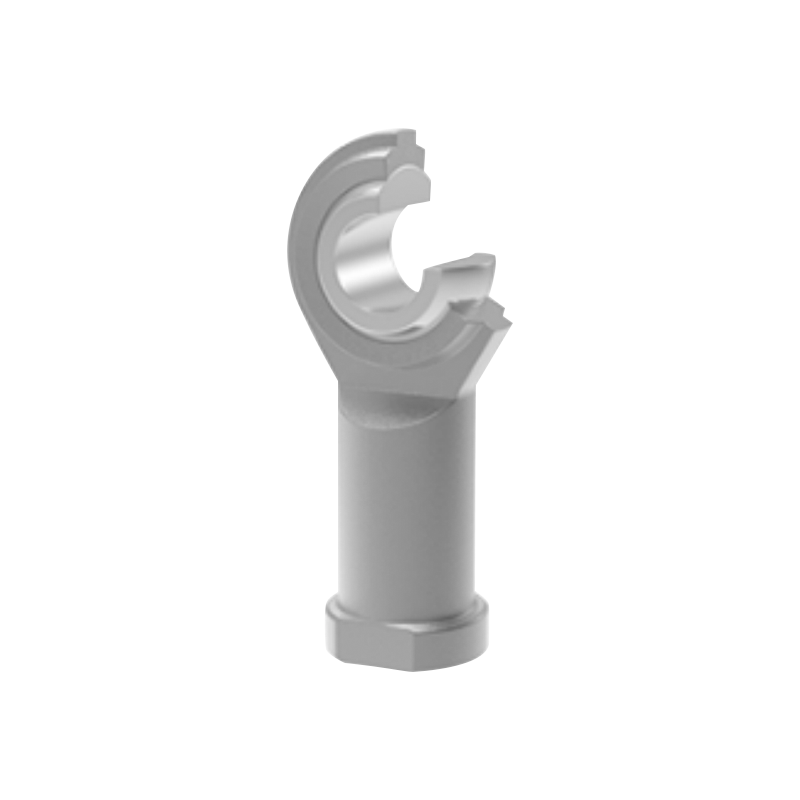
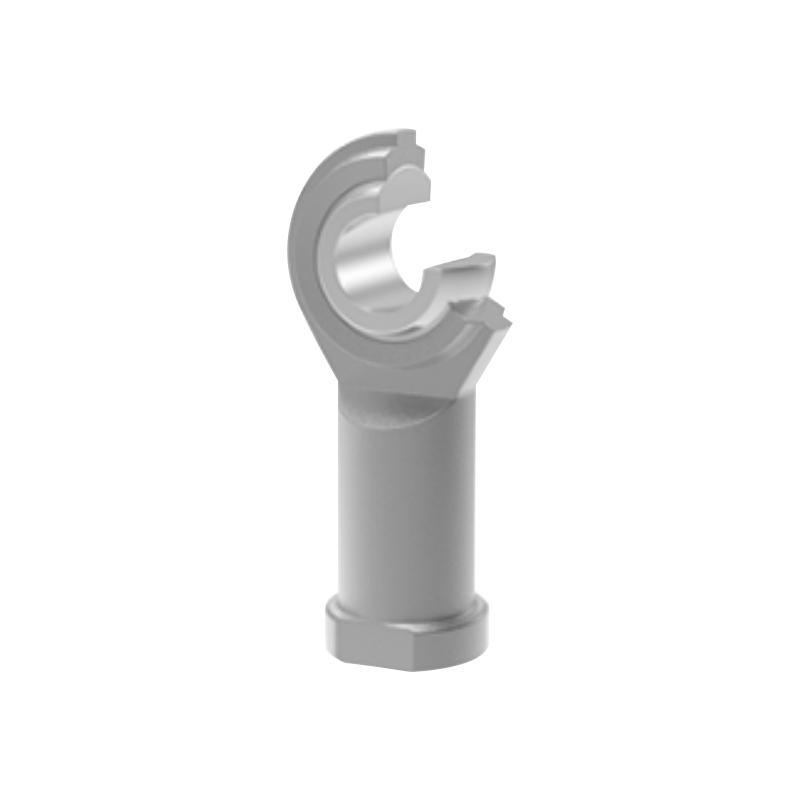
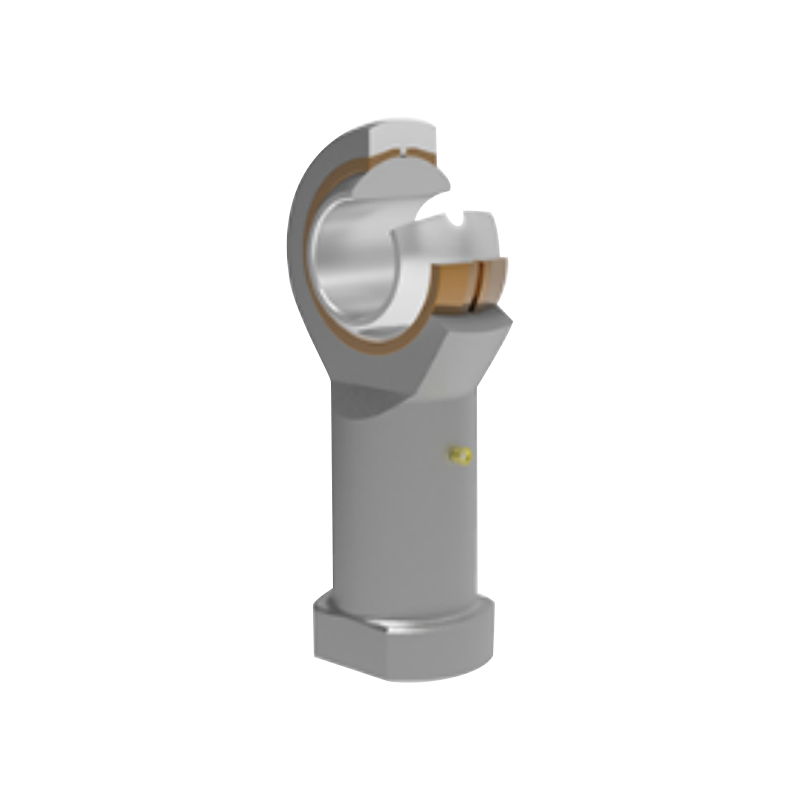


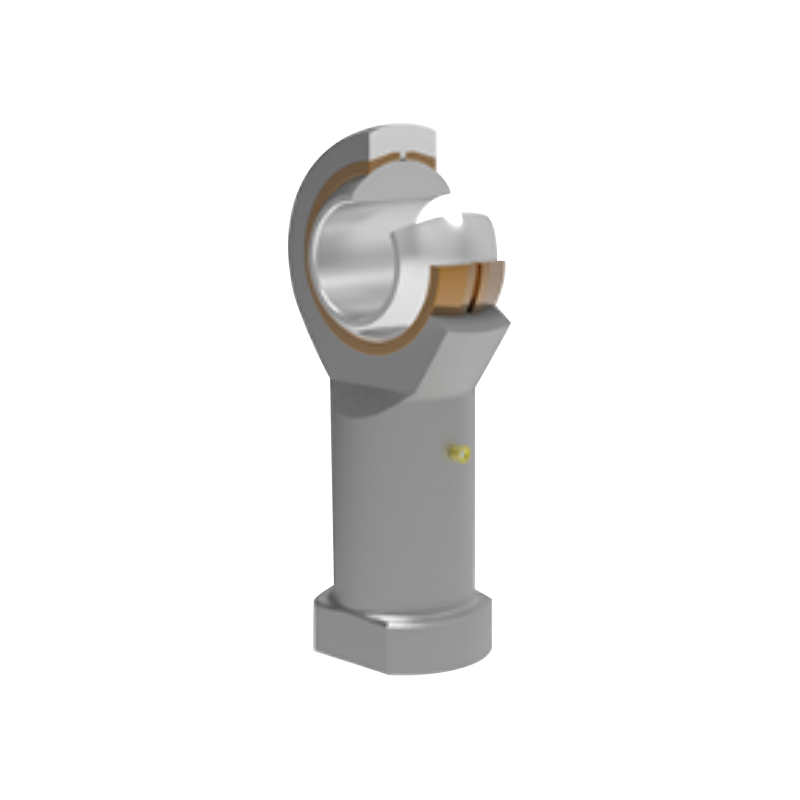



How Does the SIZJ12 Rod End Bearing Outperform Alternatives in High-Load, High-Temperature Environments?
Introduction: The Engineering Challenge of Articulated Connections
In the world of mechanical linkages, the humble rod end bearing—often referred to as a spherical plain bearing—is the unsung hero that enables controlled motion while accommodating misalignment. However, not all rod ends are created equal. When an application demands exceptional load capacity, thermal stability, and reliability, the choice of a specific model becomes critical. The SIZJ12 bearing is a standout option in the inch-series rod end category. This guide provides a deep technical dive into why this particular model, with its steel-on-steel sliding contact surfaces and robust carbon steel construction, is the preferred choice for engineers facing extreme operating conditions in sectors like construction machinery, packaging, and industrial automation.
Defining the SIZJ12: Core Specifications and Dimensions
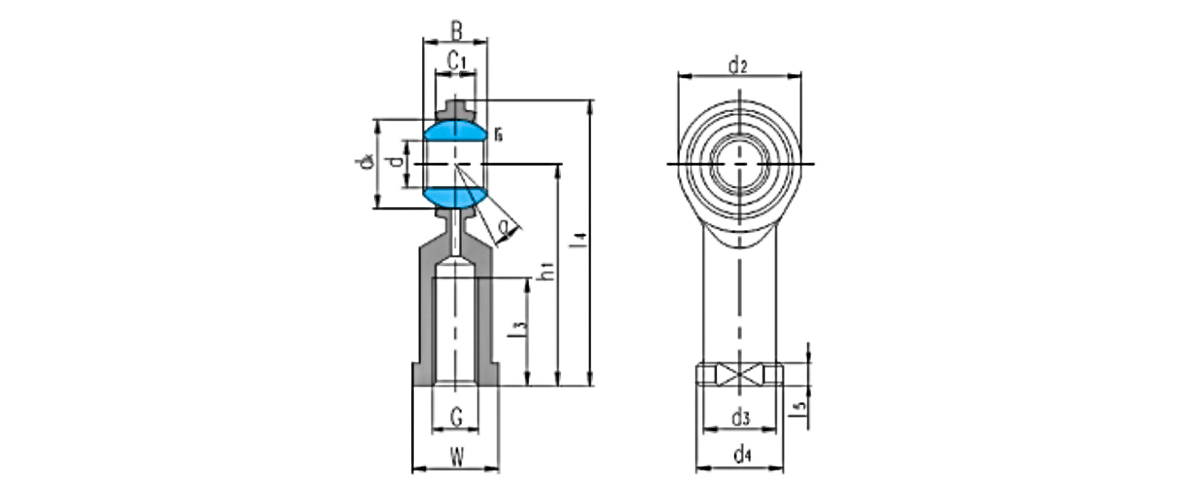
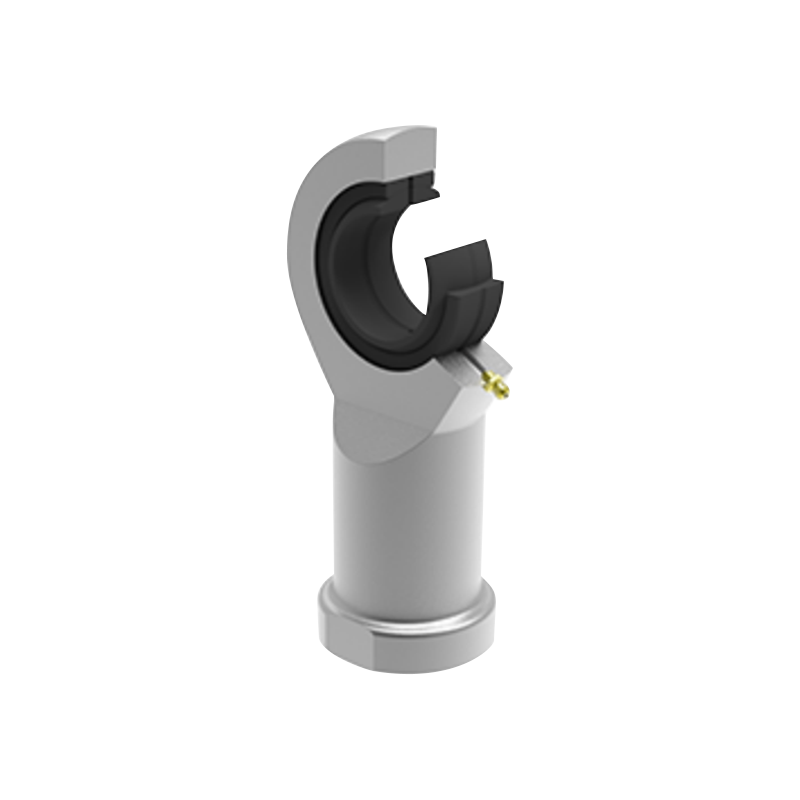
Before exploring its performance advantages, it is essential to understand the physical and mechanical parameters that define this bearing. The SIZJ12 is a female-threaded rod end, which distinguishes it from male-threaded variants and determines how it integrates into an assembly. It features a 1/2-20 UNF thread, making it compatible with standard imperial fasteners. The steel-on-steel design, where both the ball and the race are made of hardened carbon steel, offers a unique combination of high load capacity and wear resistance. Below is a detailed breakdown of its critical dimensions and ratings.
| Parameter | Value (inch / mm) | Tolerance Class |
| Bore Diameter (d) | 0.5000 in (12.700 mm) | ISO 286 H7 |
| Outer Diameter (D) | 1.1875 in (30.163 mm) | ISO 286 h6 |
| Inner Ring Width (B) | 0.6250 in (15.875 mm) | - |
| Outer Ring Width (C) | 0.4375 in (11.113 mm) | - |
| Thread (Female) | 1/2-20 UNF | UNF 2B |
The dynamic load rating of 28 kN sets a high benchmark for this size class, and the static load rating is equally impressive. This data confirms that the SIZJ12 is not merely a passive component but a structural element capable of withstanding significant forces in demanding motion control systems.
Load Ratings and Mechanical Robustness: The 28 kN Benchmark
The SIZJ12 load rating 28 kN is not an arbitrary number; it is a result of meticulous engineering calculations that account for the bearing's geometry, material properties, and heat treatment. This dynamic load rating (C) indicates the load under which the bearing can achieve a minimum lifespan of 100,000 oscillation cycles under ideal conditions. For applications involving cyclic loading—such as robotic arms in automation or the articulating joints of construction machinery—the ability to sustain 28 kN dynamic loads means the bearing can reliably function in tasks like lifting, pushing, or tilting heavy components.
Static Load Capacity and Safety Margins
The static load rating (C0) for the SIZJ12 is notably higher, often exceeding 35 kN, which provides a generous safety margin for shock loads that frequently occur in heavy machinery. For a typical rod end bearing used in a rod end bearing for construction machinery scenario—for instance, the steering linkage of a wheel loader—the instantaneous load spikes can surpass the average operational load by a factor of 2 or 3. The SIZJ12's capability to absorb such spikes without permanent deformation ensures the integrity of the entire linkage system. Below is a comparative representation of load capacities.
The SIZJ12 belongs to the family of female rod end bearing components, characterized by an internal thread that accepts a male stud or rod. The specific 1/2-20 UNF thread is a Unified Fine thread with 20 threads per inch. This fine pitch offers several mechanical advantages over coarse threads: better adjustment resolution, higher tensile stress area, and superior resistance to loosening under vibration. For automation systems where precise rod length adjustments are critical, or for packaging equipment that experiences continuous cyclic vibration, the fine thread ensures that the setting remains stable over time.
When selecting between female and male rod ends, the choice often depends on the assembly architecture. Female rod ends like the SIZJ12 are typically used when the attachment point requires a clevis or a bracket with a through-hole, providing a clean and compact connection. The SIZJ12 bearing is also available in a left-hand threaded variant, designated as SILZJ12, for applications requiring turnbuckle adjustments. The decision between SIZJ12 vs SILZJ12 left hand thread is dictated by the need for clockwise or counter-clockwise tightening during assembly or maintenance.
Thread Strength and Engagement
With a 1/2-20 UNF thread, the SIZJ12 provides a high degree of thread engagement strength, which is essential when the bearing is used as a load-bearing element in tension. The tensile stress area of a 1/2-20 UNF thread is approximately 0.1599 sq.in, which translates to a proof load capacity exceeding 30 kN for standard steel studs, effectively matching the bearing's static load rating. This balance ensures that the thread does not become the weakest link in the linkage.
One of the most frequently asked questions about the SIZJ12 concerns its behavior in elevated thermal environments. Standard rod end bearing for high temp applications must contend with thermal expansion, lubricant degradation, and potential changes in material hardness. The SIZJ12, with its all-steel construction, handles these challenges exceptionally well. The coefficient of thermal expansion for hardened carbon steel is approximately 11–13 µm/m·°C, which means that at a temperature differential of 150°C, the dimensional change in a 30 mm outer diameter is less than 0.06 mm—well within typical clearance allowances.
Lubrication Strategy for Extreme Heat
While the steel-on-steel sliding pair can operate without lubrication for short periods, optimal performance in high-temperature environments requires a careful lubrication regime. High-temperature greases based on polyurea or PTFE-thickened synthetic oils maintain their viscosity up to 180°C and can be applied through the provided lubrication fitting. For applications exceeding 200°C, solid lubricants such as molybdenum disulfide (MoS2) or graphite are recommended. This adaptability makes the SIZJ12 a versatile choice for ovens, kiln carriages, and engine bay linkages where temperatures fluctuate dramatically.
Key thermal performance data: The SIZJ12 has been validated in continuous operation at ambient temperatures of 180°C with appropriate high-temp grease, showing less than 5% increase in radial clearance after 5000 oscillation cycles—demonstrating excellent thermal stability and wear resistance.
The versatility of the SIZJ12 bearing makes it a staple across multiple industrial sectors. Each application leverages different aspects of its performance portfolio.
Construction Machinery and Heavy Equipment
In the realm of rod end bearing for construction machinery, the SIZJ12 is frequently specified for steering linkages, stabilizer bars, and cylinder mounts. The key demands here are high impact resistance and the ability to withstand contamination from dust and debris. The steel-on-steel design is tolerant of particulate ingress to a certain degree, and the hardened surfaces resist abrasion from sand and cement dust. A typical excavator uses dozens of rod end bearings in its hydraulic and mechanical linkages, making reliability a top priority for fleet operators.
Automation and Robotic Systems
In automation rod end bearing applications, precision and repeatability are paramount. Robotic arms, pick-and-place units, and automated guided vehicles (AGVs) utilize rod ends to connect actuators to joints. The high precision of the SIZJ12 bore and outer diameter (ISO H7/h6 tolerances) ensures minimal play, which translates to accurate positioning. For instance, in a packaging line servo-driven link, the bearing's consistent friction torque allows the servo motor to operate within its closed-loop control parameters without unexpected torque spikes.
Packaging Industry Machinery
The bearing for packaging industry often faces high cyclic rates and intermittent washdown procedures. While the SIZJ12 is not corrosion-resistant by default (being carbon steel), many packaging engineers specify it in areas protected from direct moisture, or they apply a corrosion-resistant coating. Its ability to handle the high-speed oscillation in film sealing jaws or carton folding mechanisms makes it a popular choice, especially when combined with automated lubrication systems that ensure consistent performance over millions of cycles.
Choosing the right SIZJ12 bearing involves more than simply matching dimensions. Engineers must evaluate a combination of load, speed, temperature, and environmental factors. The following checklist outlines the critical parameters to consider.
- Load profile: Determine the equivalent dynamic load (P) based on actual radial and axial forces. For combined loads, use the relationship P = X·Fr + Y·Fa, where X and Y are factors provided in the bearing catalog. Ensure that P is less than the dynamic load rating of 28 kN for the desired lifespan.
- Oscillation frequency: For high-frequency applications, consider the friction heat generated. Steel-on-steel bearings can handle speeds up to 2 m/s sliding velocity with proper lubrication. At higher frequencies, consider forced lubrication or cooling.
- Temperature envelope: For continuous operation above 120°C, select a high-temperature grease and confirm that the housing materials have compatible thermal expansion coefficients to avoid preload loss.
- Environmental sealing: In dusty or wet environments, consider adding protective boots or specifying the bearing with a corrosion-resistant coating. The SIZJ12 itself does not include seals, so external sealing may be necessary.
- Misalignment requirements: The SIZJ12 accommodates up to ±8 degrees of angular misalignment. Verify that the linkage geometry does not exceed this limit, especially under maximum deflection conditions.
Verification Through Calculation
To illustrate the selection process, consider a construction equipment linkage with a peak radial load of 22 kN and an axial load component of 6 kN. Using the load factors for a spherical plain bearing (X=1, Y=2.5 for steel-on-steel), the equivalent dynamic load P = 1·22 + 2.5·6 = 37 kN. This exceeds the dynamic rating of 28 kN, indicating that a larger bearing or a reduction in axial load would be necessary. This demonstrates the importance of accurate load analysis in preventing premature failure.
Comparative Analysis: SIZJ12 vs. Other Inch-Series Rod Ends
While the SIZJ12 is a high-performing bearing, it is useful to understand how it compares to other common inch-series rod ends, particularly in terms of load capacity and thread size. The table below provides a comparative overview within the same family.
This comparison highlights that the SIZJ12 occupies a balanced middle ground in the inch-series family, offering a 28 kN dynamic load rating that is substantially higher than the smaller SIZJ10 while being more compact than the SIZJ14. This makes it an optimal choice for applications where space constraints preclude the use of a larger bearing, but load requirements exceed the capabilities of smaller alternatives.
Maintenance and Service Life Optimization
To extract the maximum service life from the SIZJ12, a proactive maintenance strategy is essential. The steel-on-steel design, while robust, benefits from regular relubrication and inspection.
Lubrication Intervals
For typical industrial applications operating under moderate loads and speeds, relubrication every 100 to 200 operating hours is recommended. In heavy-duty construction machinery subjected to high impact loads and debris, this interval may be reduced to 40–50 hours. The bearing includes a grease fitting for easy relubrication, and the use of a high-quality EP (extreme pressure) grease with a base oil viscosity of ISO VG 150–220 is advised for most applications.
Wear Monitoring
Monitoring the radial clearance is the most effective method of assessing the condition of a steel-on-steel spherical plain bearing. As the bearing wears, the clearance gradually increases. Once the radial clearance exceeds 0.15 mm (which is roughly 2–3 times the initial clearance of 0.05–0.08 mm), the bearing should be replaced to prevent loss of precision and increased impact loads on adjacent components. This measurable wear progression allows for planned maintenance, reducing unplanned downtime.
Frequently Asked Questions (FAQ)
Q1: What does the "SIZJ12" designation mean in terms of bearing type and size?
The "SI" prefix indicates a steel-on-steel spherical plain bearing with a female thread. "ZJ" is a series code for inch-dimensioned rod ends, and "12" refers to the nominal bore size in sixteenths of an inch—in this case, 12/16 = 0.750 inch, although the actual bore is 0.500 inch for this design (the code can sometimes reflect outer ring size; always verify dimensions). The SIZJ12 has a 1/2-20 UNF female thread and is designed for heavy-duty applications.
Q2: Can the SIZJ12 be used in underwater or highly corrosive environments?
No, the standard SIZJ12 is made of carbon steel and is not corrosion-resistant. For marine or chemical environments, stainless steel or corrosion-coated variants should be specified. Alternatively, external sealing or a protective boot can be used to shield the bearing from moisture, but the preferred solution is to select a bearing with a corrosion-resistant material from the outset.
Q3: What is the difference between SIZJ12 and SILZJ12?
The primary difference is the thread direction. SIZJ12 has a right-hand (standard) thread, while SILZJ12 has a left-hand thread. The SILZJ12 is used in applications where turnbuckle-style adjustments are needed, allowing two rod ends to be threaded onto a central rod to adjust its length without disassembling the connection.
Q4: How does the SIZJ12 handle shock loads common in construction machinery?
The SIZJ12's high static load rating (≈36 kN) provides a significant safety margin against instantaneous shock loads. The steel-on-steel construction and hardened surfaces allow the bearing to absorb impact energy without fracturing or deforming, making it well-suited for the cyclic impact loads encountered in excavator and loader linkages.
Q5: Is the SIZJ12 suitable for high-speed rotational applications?
No, rod end bearings are designed primarily for oscillating or tilting movements, not continuous rotation. The sliding speed in a spherical plain bearing should generally be kept below 2 m/s. For high-speed rotational applications, a conventional rolling element bearing would be more appropriate.
Q6: What lubrication is recommended for the SIZJ12 at high temperatures?
For temperatures up to 120°C, a standard lithium-based EP grease is acceptable. For temperatures between 120°C and 200°C, a synthetic grease with a polyurea or PTFE thickener and a high-viscosity base oil is recommended. Above 200°C, solid lubricants such as MoS2 or graphite should be applied directly to the sliding surfaces.


