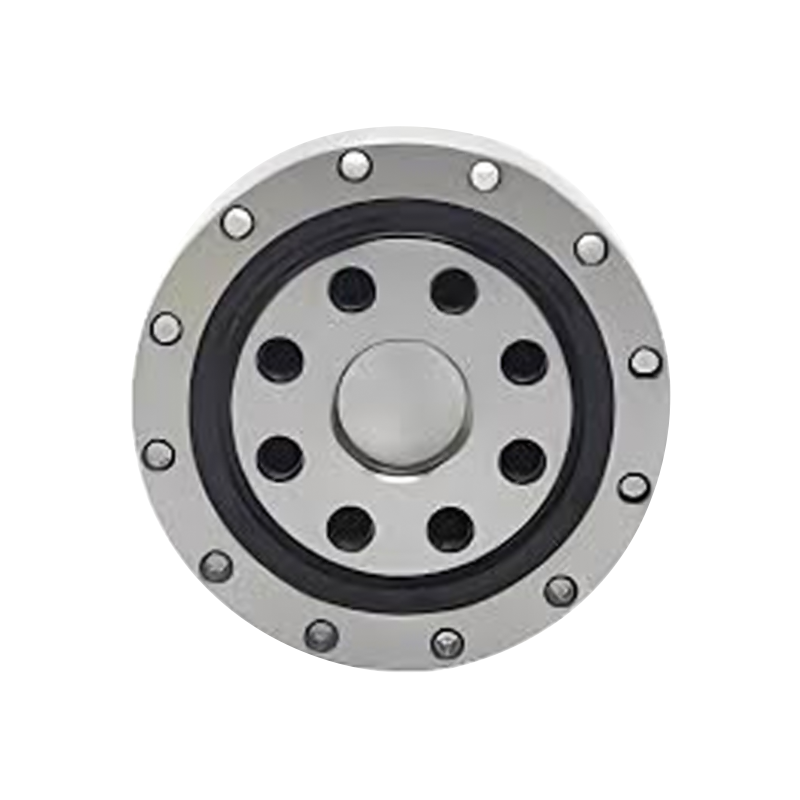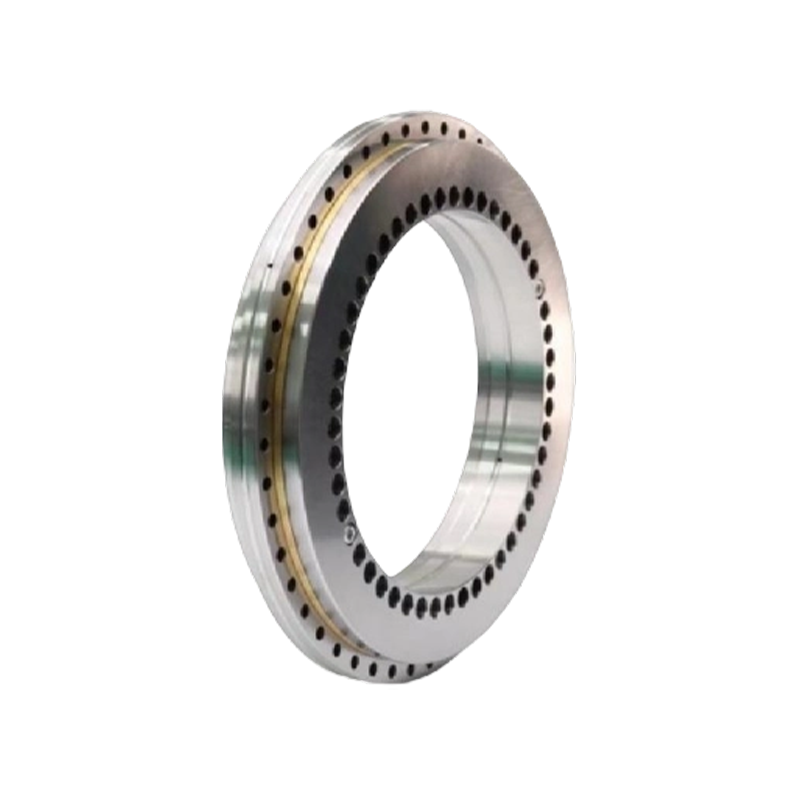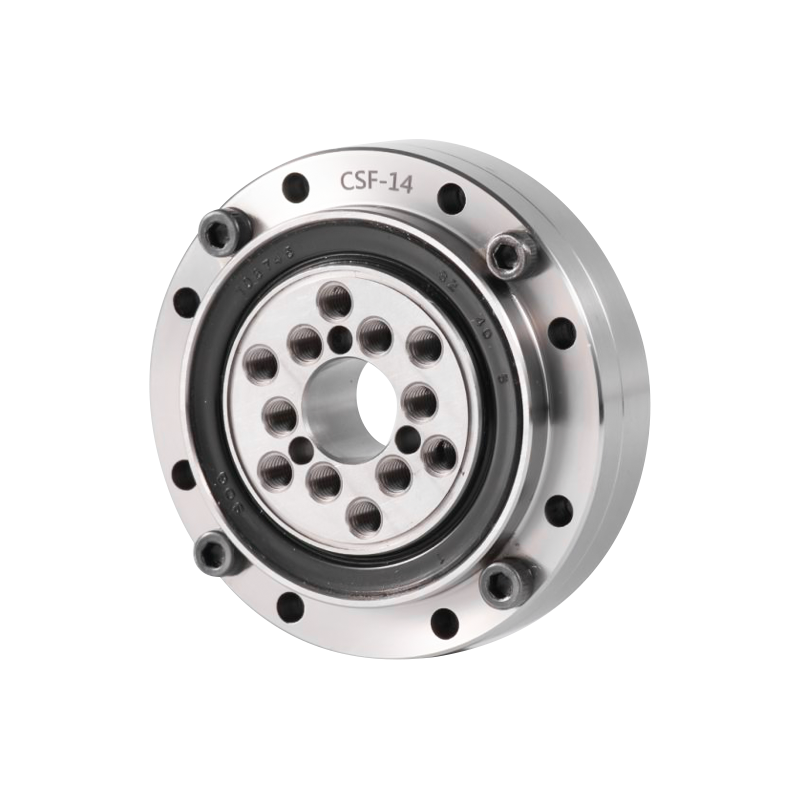
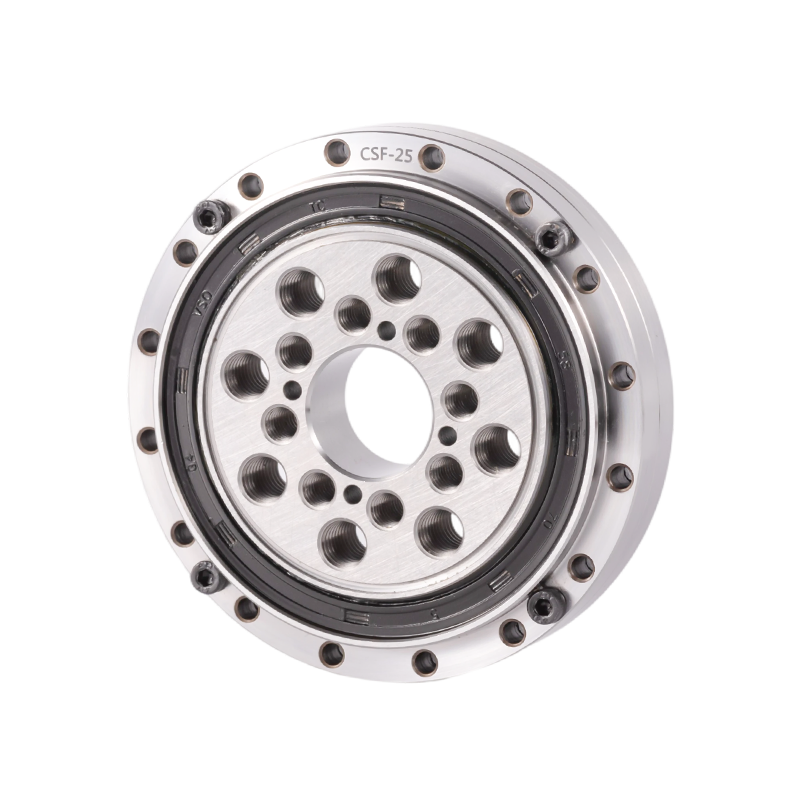
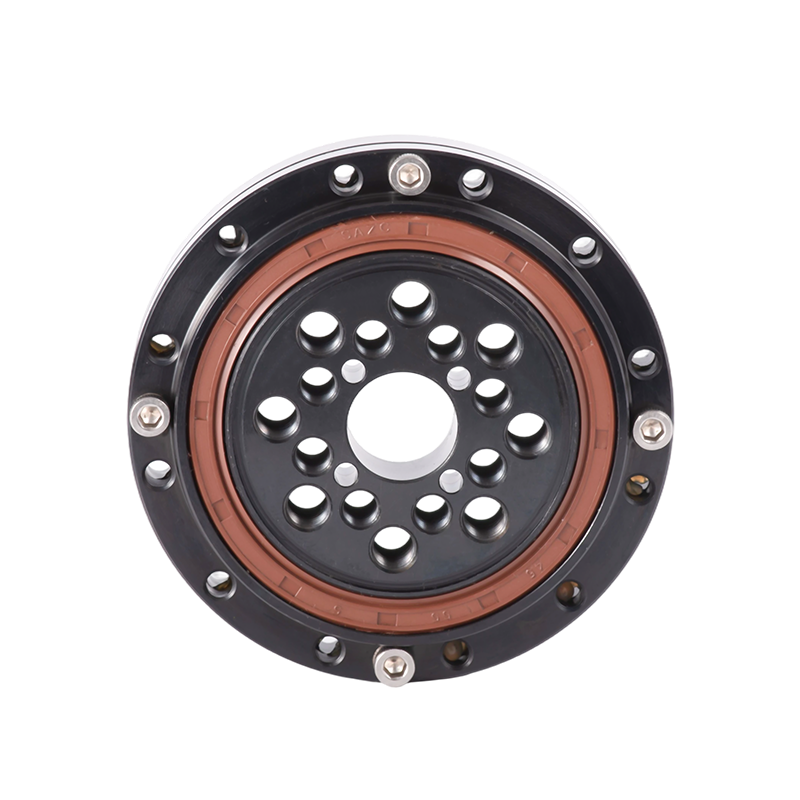
A harmonic reducer mainly consists of three basic components: a harmonic generator, a flexure, and a rigid wheel. It also includes a rigid bearing (usually a crossed roller bearing) and a flexible bearing (thin-walled deep groove ball bearing).
The inner bore of the flexible bearing mates with the outer ring of an elliptical cam. The outer ring undergoes elastic deformation through rolling balls and mates with the inner diameter of the flexure's opening. The outer circumference of the flexure's opening is machined with teeth that mesh with the teeth of the rigid wheel. Since the rigid wheel has more teeth than the flexure, they mesh at the long axis and disengage at the short axis. The bottom of the flexure is fixed to the output end, while the rigid bearing is installed at the reducer's output end for external connection.
Harmonic reducers are widely used in industries such as robotics, machine tools, and aerospace. They require extremely high precision, rigidity, and load-bearing capacity, thus imposing strict standards on the machining and assembly precision of all components, especially bearing performance.
For rigid bearings, key indicators are rigidity, reliability, and rotational accuracy. Preload is typically applied before shipment to ensure rigidity. For flexible bearings, the maximum radial deformation is the core performance parameter.
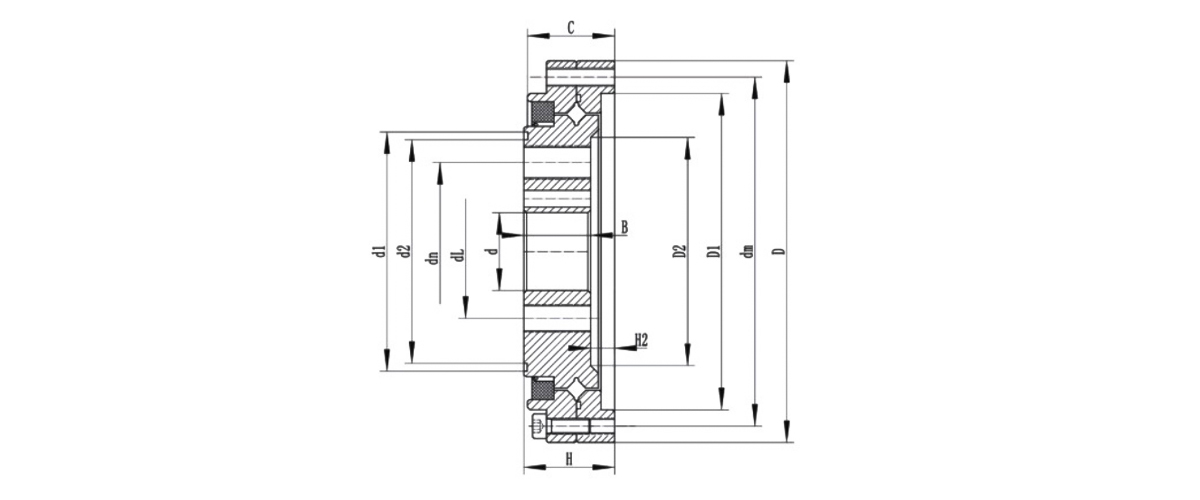
| Bearing type | Overall Dimension(mm) | Installation Hole Size(PCD&SPEC) | Weight | |||||||||
| D | d | C | H | B | dm | dn | dl | kg | ||||
| CSF(G)-14 | 55 | 11 | 16 | 16.5 | 13.5 | 49 | 8-φ3.5 | 23 | 6-M4 | 17 | 6-M4 | 0.15 |
| CSF(G)-17 | 62 | 10 | 16 | 16.5 | 13.5 | 56 | 10-φ3.5 | 27 | 6-M5 | 19 | 6-M5 | 0.24 |
| CSF(G)-20 | 70 | 14 | 16 | 16.5 | 13.5 | 64 | 12-φ3.5 | 32 | 8-M6 | 24 | 8-M5 | 0.3 |
| CSF(G)-25 | 85 | 20 | 18 | 18.5 | 16.5 | 79 | 16-φ3.5 | 42 | 8-M8 | 30 | 8-M6 | 0.45 |
| CSF(G)-32 | 112 | 26 | 21.5 | 22.5 | 19 | 104 | 16-φ4.5 | 55 | 8-M10 | 40 | 8-M8 | 0.9 |
| CSF(G)-40 | 126 | 24/32 | 22.5 | 24 | 21.5 | 117 | 20-φ5 | 68 | 8-M10 | 50 | 8-M10 | 1.3 |
| CSF(G)-50 | 157 | 32/40 | 30 | 31 | 28 | 147 | 16-φ5.5 | 84 | 8-M14 | 60 | 8-M14 | 2.8 |
| CSF(G)-65 | 210 | 44/52 | 37 | 39 | 35 | 198 | 20-φ6.5 | 110 | 8-M16 | 80 | 8-M16 | 7.9 |

0+
years
Industry Experience

0+
Model diversity

0+
Number of Employees

0
$
Annual export value

Why the 22205 e Bearing Matters in Heavy Equipment When engineers specify a double row spherical roller bearing for a demanding drive, the 22205 e bearing often appears near the top of the shortlist....
Engineers comparing 3200 a-2ztn9/mt33 double row angular contact ball bearings against other shaft support options usually start with one question: how do you keep a shaft rigid enough to resist til...
In the realm of precision motion control, the demand for bearings that can simultaneously handle axial, radial, and tilting moments is relentless. The ZKLDF100 bearings represent a specialized class ...
Understanding the XSU080168 Crossed Roller Bearing When precision, rigidity, and moment load capacity converge, the XSU080168 emerges as a critical component in rotating machinery. This thin-walled ...
Product Categories
Contact Us

Jane@ukl-bearing.com
Jenny@ukl-bearing.com
Andy@ukl-bearing.com
Ivy@ukl-bearing.com

+86-510- 88763239
+86-15371057968

No.1 Hehuan Road, Hudai Town, Binhu District, Wuxi City.
Ready to Begin?
Get in Touch

Now!

UKL BEARING
 English
 Español
 русский