Content
The landscape of global industrial manufacturing is currently undergoing a profound transformation. As we move further into 2026, the demand for precision, efficiency, and ultra-compact design has reached an all-time high. This evolution is driven by the rapid advancement of high-tech sectors such as industrial robotics, medical diagnostics, and semiconductor fabrication. In these sophisticated environments, the performance of a machine is no longer judged solely by its power, but by the microscopic accuracy and reliability of its moving parts. At the heart of this mechanical excellence lies the bearing—a component that, while often hidden from view, determines the ultimate success of complex automated systems.
In the contemporary engineering world, selecting the right bearing is no longer a routine procurement task; it is a critical strategic decision. Engineers and designers are constantly challenged to balance competing requirements. On one hand, there is the need for components that can withstand multi-directional loads and high stress. On the other hand, there is an increasing pressure to reduce the footprint and weight of machinery to improve energy efficiency and speed. This has led to a pivotal technical crossroad: choosing between the established versatility of traditional ball bearings and the high-density performance of cross roller bearings.
As a professional bearing factory and integrated industrial enterprise based in Wuxi, UKL Bearing Manufacturing Company Limited understands these challenges intimately. Founded in 2020 and built upon a foundation of over 15 years of OEM and ODM export experience, our company has witnessed the shift from standard industrial applications to the high-precision demands of the modern era. We have seen how the wrong bearing selection can lead to catastrophic equipment failure, increased maintenance costs, and lost productivity. Conversely, the right choice can unlock new levels of performance, allowing a robotic arm to move with fluid grace or a medical scanner to produce crystal-clear imagery.
Our mission is to provide technical support for global industries that refuse to compromise on precision. By combining a modernized production base with deep research and development capabilities, UKL responds quickly to the evolving needs of clients across Europe, Asia, Africa, and the Middle East. This article serves as a comprehensive guide to help you navigate the complexities of bearing technology. By exploring the fundamental differences between cross roller bearings and ball bearings, we aim to provide you with the insights needed to make an informed decision for your next high-performance project.
To appreciate why a specific bearing is chosen for a high-tech application, one must first understand the internal mechanics that distinguish cross roller bearings from traditional ball bearings. While both components serve the primary purpose of reducing friction and supporting rotational motion, their internal architectures are fundamentally different. These differences dictate how they respond to stress, how accurately they rotate, and how much physical space they occupy within a mechanical assembly.
The most significant distinction lies in the contact geometry between the rolling elements and the raceways. Standard ball bearings utilize spherical balls as the rolling medium. These spheres make point contact with the curved raceways of the inner and outer rings. Because the contact area is a single point, friction is minimized, which allows ball bearings to reach exceptionally high rotational speeds without generating excessive heat. However, this small contact area also means that under heavy loads, the balls may experience significant elastic deformation, which can limit the overall rigidity of the system.
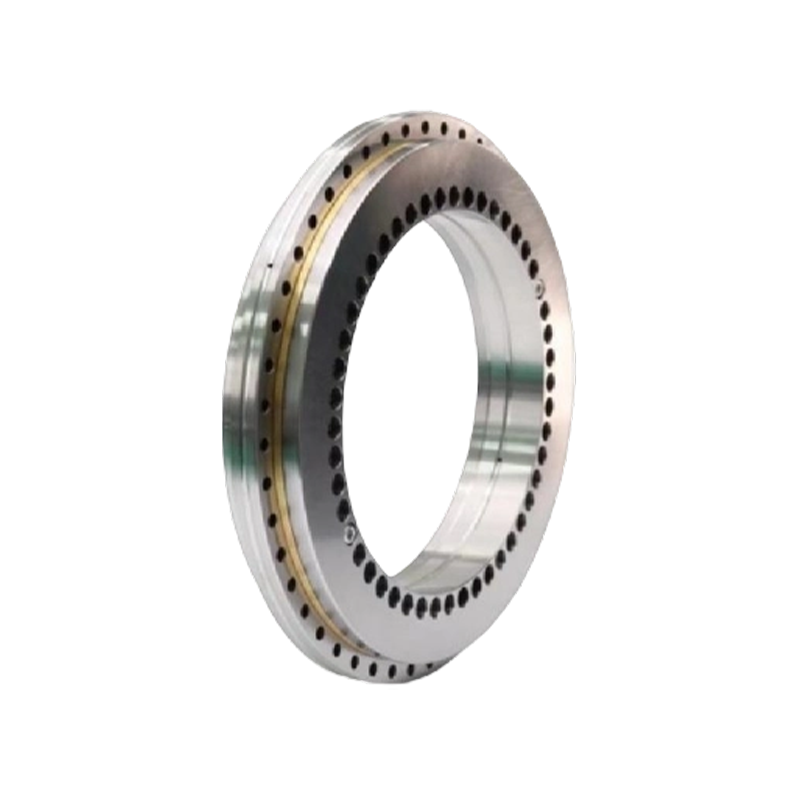
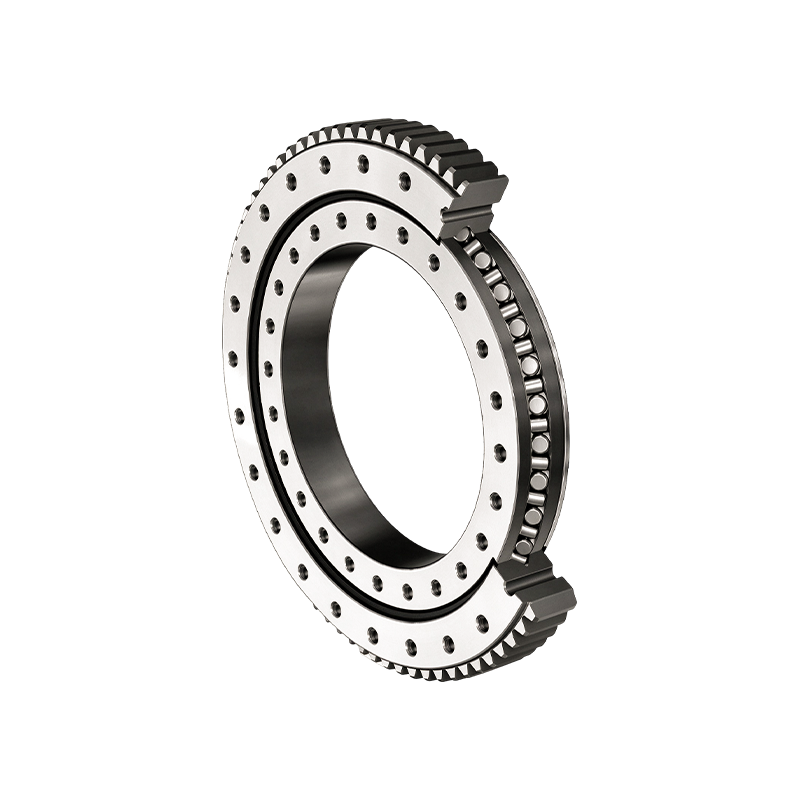
In contrast, cross roller bearings utilize cylindrical rollers. These rollers are arranged orthogonally, meaning each roller is positioned at a 90-degree angle relative to the adjacent one, nestled within a V-shaped raceway. This configuration results in line contact rather than point contact. The rollers distribute the load across a much wider surface area, which provides a dramatic increase in mechanical stiffness and load-carrying capacity. This line contact ensures that even under immense pressure, the bearing maintains its structural integrity and rotational precision.
Another operational difference is the ability to handle complex loads. In many industrial applications, a bearing must support radial loads, axial loads, and tilting moment loads simultaneously. To achieve this with ball bearings, engineers often have to use two bearings mounted in a specific configuration, such as back-to-back or face-to-face angular contact pairs. This adds weight, increases the complexity of the housing, and requires more space.
Cross roller bearings are inherently designed to be all-in-one solutions. Because the rollers are crossed at right angles, a single bearing unit can handle radial, axial, and moment loads from all directions at the same time. This consolidated design is a game-changer for modern equipment designers who are looking to downsize their machines while increasing performance.
The following table highlights the key structural differences between these two essential bearing technologies:
| Feature | Ball Bearings (Deep Groove/Angular) | Cross Roller Bearings |
|---|---|---|
| Rolling Element | Spherical Balls | Cylindrical Rollers |
| Contact Type | Point Contact | Line Contact |
| Raceway Geometry | Curved Grooves | 90-Degree V-Grooves |
| Load Handling | Primarily Radial or Single-Way Axial | Simultaneous Radial, Axial, and Moment |
| Assembly Requirement | Often requires pairs for complex loads | Single unit is sufficient |
| Mechanical Rigidity | Moderate | Exceptionally High |
At UKL Bearing Manufacturing Co., Ltd., we utilize our 15 years of industry experience to help clients identify which of these structures best fits their operational environment. Our production base in Wuxi is equipped to manufacture both types to the highest precision standards, ensuring that whether you need the high-speed capability of a ball bearing or the extreme rigidity of a cross roller bearing, the quality remains consistent.
Having established the structural differences, it is essential to evaluate how these two bearing types perform across key technical metrics. For engineers, the selection process is often a strategic balancing act between load-carrying capacity, rotational precision, and physical footprint.
Load capacity is often the primary metric for industrial components. Because cross roller bearings utilize line contact, their effective pressure area is significantly larger than the point contact found in ball bearings. This enables a cross roller bearing to support radial and axial loads that would typically overwhelm a ball bearing of the same dimensions.
Furthermore, line contact translates directly into superior mechanical rigidity. When subjected to heavy weights or tilting moments, the elastic deformation within a cross roller bearing is minimal. Based on comparative testing data from UKL’s production base in Wuxi, cross roller bearings typically offer three to four times the mechanical stiffness of comparable angular contact ball bearings. This high rigidity is a non-negotiable requirement for precision CNC machine tools and robotic joints that must maintain absolute positioning under stress.
Rotational accuracy determines the final quality of the manufactured product. While ball bearings perform exceptionally well at high speeds, their accuracy can be compromised in complex load scenarios where multiple bearings must be synchronized. The cumulative tolerances of two or more bearings can lead to increased runout.
The unique orthogonal arrangement of rollers in a cross roller bearing prevents rollers from skewing or experiencing “cage crawl,” which effectively suppresses radial runout and axial displacement. At UKL, we utilize precision CNC grinding and super-finishing to elevate our cross roller bearings to P4 or even P2 precision grades. This extreme rotational stability makes them the standard choice for semiconductor manufacturing equipment and high-precision rotary tables.
Modern industrial design is centered on the pursuit of lightweight and compact solutions. Traditional ball bearing configurations designed to handle moment loads often require a complex housing to support two separate bearing units, along with spacers and covers.
The defining advantage of the cross roller bearing is its ability to replace two bearings with a single integrated unit. This “two-in-one” capability not only drastically reduces the physical space required for the bearing seat but also significantly minimizes the overall weight of the assembly. For automated equipment that requires frequent starting and stopping—such as robotic arms—this reduction in weight leads to lower inertia and improved energy efficiency.
The following table provides a direct comparison of these two essential technologies across core performance dimensions:
| Performance Metric | Ball Bearings | Cross Roller Bearings |
|---|---|---|
| Load Capacity | Moderate | Exceptionally High |
| Mechanical Rigidity | Standard | Superior (3-4x higher) |
| Rotational Accuracy | High (installation dependent) | Ultra-High (inherent stability) |
| Space Requirement | Large (usually requires pairs) | Minimal (highly integrated) |
| Maximum Speed | Ultra-High (low heat generation) | Moderate (higher contact area) |
| Shock Resistance | Moderate | Excellent (line contact resilience) |
As an integrated industrial and trading enterprise with 15 years of OEM/ODM export experience, UKL focuses on aligning these performance metrics with the specific environmental conditions of our clients. We understand that the true value of a bearing is realized when its technical strengths perfectly match the duty cycle of the machine it supports.
Selecting between a ball bearing and a cross roller bearing is rarely about which technology is “better” in a vacuum; rather, it is about which technology is optimized for the specific demands of the application. In this chapter, we analyze the primary sectors where these bearings are deployed and determine which one emerges as the superior choice based on operational requirements.
Ball bearings remain the most widely used bearing type globally due to their versatility and cost-effectiveness. They are the clear winners in applications where high rotational speed and low friction are the primary concerns.
As industry 4.0 pushes for smarter, smaller, and more precise machines, cross roller bearings have become the preferred solution for high-end automation. They win in environments characterized by complex loads and spatial constraints.
| Industry Sector | Recommended Bearing | Primary Reason for Selection |
|---|---|---|
| Collaborative Robots (Cobots) | Cross Roller Bearing | Compactness and moment load handling |
| High-Speed CNC Spindles | Angular Contact Ball | Low heat at high RPM |
| Semiconductor Handling | Cross Roller Bearing | High rotational precision and stiffness |
| Household Electronics | Deep Groove Ball | Low cost and high-speed efficiency |
| Satellite Radar Pedestals | Cross Roller Bearing | Stability in harsh, tilting environments |
At UKL Bearing Manufacturing Co., Ltd., our 15 years of OEM/ODM experience has taught us that the boundaries between these applications are constantly shifting. We work closely with our clients in Europe, Asia, and the Middle East to provide flexible and customized services, ensuring that whether a project calls for a high-speed ball bearing or a high-torque cross roller bearing, the component is perfectly tuned for its final role.
Understanding the technical differences between bearing types is only half of the equation; the other half is the quality of execution. At UKL Bearing Manufacturing Co., Ltd. (Wuxi), we believe that the performance of a cross roller bearing or a ball bearing is a direct reflection of the integrity of its manufacturing process. As an integrated industrial and trading enterprise, we do not simply assemble parts; we control every micrometer of the production journey.
The “UKL Edge” is rooted in our fully modernized production base. Unlike many suppliers who outsource critical stages, our facility in Wuxi manages the entire lifecycle of the bearing. This vertical integration is essential for maintaining the exceptionally high demands for precision and reliability required by global industries.
Founded in 2020, but built upon a legacy of over 15 years of export experience, UKL has developed a deep understanding of the global market. We do not just offer products; we offer flexible and customized services.
For our clients in Europe, Asia, Africa, and the Middle East, we provide:
Quality is not an afterthought at UKL; it is our guiding principle. Every bearing that leaves our factory is a testament to our commitment to excellence.
| Manufacturing Stage | UKL Quality Standard | Benefit to Customer |
|---|---|---|
| Raw Material | High-Purity GCr15 Steel | Extended fatigue life and reliability |
| Tolerance Grade | P5, P4, and P2 available | High-speed stability and precision |
| Inspection | 100% Noise & Vibration Testing | Smooth, quiet operation in the field |
| Traceability | Full batch tracking | Consistent quality and accountability |
By choosing UKL Bearing Manufacturing Co., Ltd., you are partnering with a company that combines the agility of a modern enterprise with the technical depth of an industry veteran. We are dedicated to providing the high-performance bearing solutions that empower the next generation of global industry.
As the global manufacturing sector moves toward a future defined by higher precision and more compact automation, the choice between ball bearings and cross roller bearings has never been more consequential. While the ball bearing remains a versatile and indispensable component for high-speed, light-duty applications, the cross roller bearing is clearly the champion for modern robotics and CNC technologies where rigidity and space optimization are paramount.
The decision-making process for your next project should not be based on a single factor, but on a holistic view of your operational requirements. Choosing the wrong bearing can lead to premature mechanical failure, while over-engineering can lead to unnecessary costs.
To assist your engineering and procurement teams, we have developed a final checklist based on the technical standards maintained at UKL Bearing Manufacturing Co., Ltd. (Wuxi):
At UKL, we bridge the gap between technical theory and industrial reality. With over 15 years of OEM/ODM export experience, we have helped hundreds of clients in Europe, Asia, and the Middle East select and customize the perfect bearing for their specific duty cycles. Our modernized production base in Wuxi stands ready to deliver everything from high-speed spindle ball bearings to ultra-rigid cross roller units, all manufactured to P4 or P2 precision grades.
The “Precision Revolution” is here, and your equipment deserves components that can keep pace with the exceptionally high demands of tomorrow. By focusing on integrated manufacturing, rigorous heat treatment, and automated quality control, UKL ensures that every bearing we ship is a reliable foundation for your success.
1. Why is a cross roller bearing more rigid than a ball bearing of the same size?
The difference lies in the contact geometry. A ball bearing makes “point contact” with the raceway, which is prone to microscopic elastic deformation under heavy loads. A cross roller bearing uses cylindrical rollers that make “line contact.” This significantly increases the load-bearing surface area, resulting in a mechanical stiffness that is typically three to four times higher than that of a ball bearing.
2. Can I replace a pair of angular contact ball bearings with a single cross roller bearing?
In many cases, yes. One of the primary advantages of the cross roller design is its ability to handle radial, axial, and moment loads simultaneously within a single unit. This “two-in-one” functionality allows engineers to simplify their designs, reduce the number of components, and save significant space in applications like robotic joints or rotary tables.
3. Do cross roller bearings require special mounting conditions?
Because cross roller bearings are exceptionally rigid, they are less forgiving of mounting surface irregularities than ball bearings. To maintain their high precision (P4 or P2 grades), the mounting housing and shaft must be machined to high tolerances. At UKL, we provide detailed technical support and drawings to ensure your assembly environment matches the precision of the bearing.
4. Which bearing type is better for high-speed vacuum or cleanroom environments?
Both can be used, but the choice depends on the load. Ball bearings generate less heat at high speeds, which is beneficial in vacuums where heat dissipation is difficult. however, cross roller bearings are often preferred in semiconductor cleanrooms for their stability. UKL offers customized services, including specialized vacuum-grade lubricants and stainless steel materials, for both types to suit these sensitive environments.
5. How does UKL ensure the reliability of bearings exported to global markets?
With over 15 years of OEM/ODM export experience, UKL implements a rigorous “Full-Process Control” system at our Wuxi base. This includes using high-purity steel, specialized heat treatment for dimensional stability, and 100% automated inspection for noise and vibration. We ensure that every bearing shipped to Europe, Asia, or the Middle East meets international precision standards.
Product Categories
Contact Us

Jane@ukl-bearing.com
Jenny@ukl-bearing.com
Andy@ukl-bearing.com
Ivy@ukl-bearing.com

+86-510- 88763239
+86-15371057968

No.1 Hehuan Road, Hudai Town, Binhu District, Wuxi City.
Ready to Begin?
Get in Touch

Now!
UKL BEARING
 English
 Español
 русский