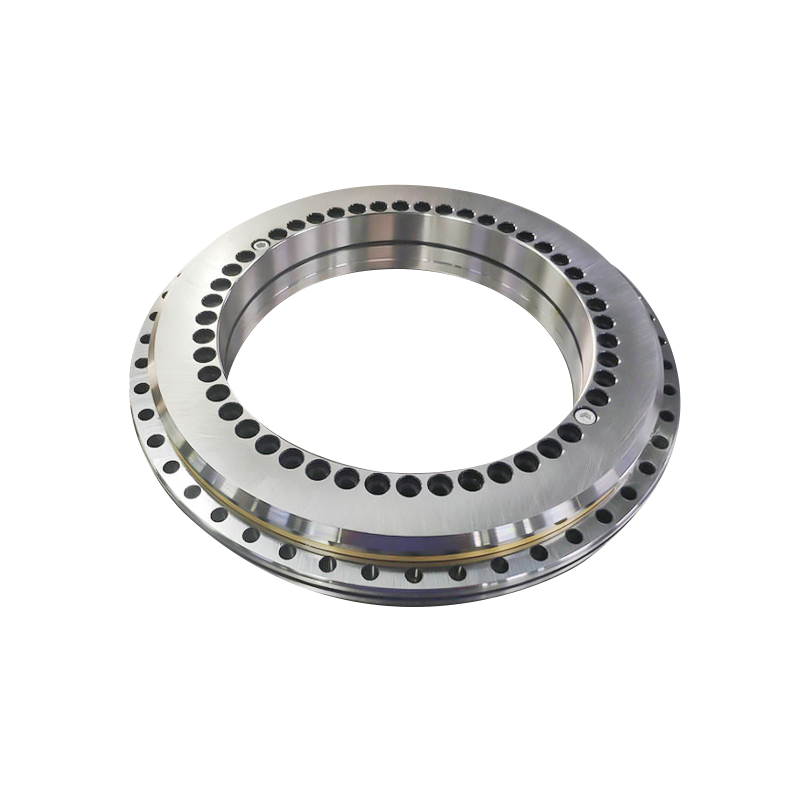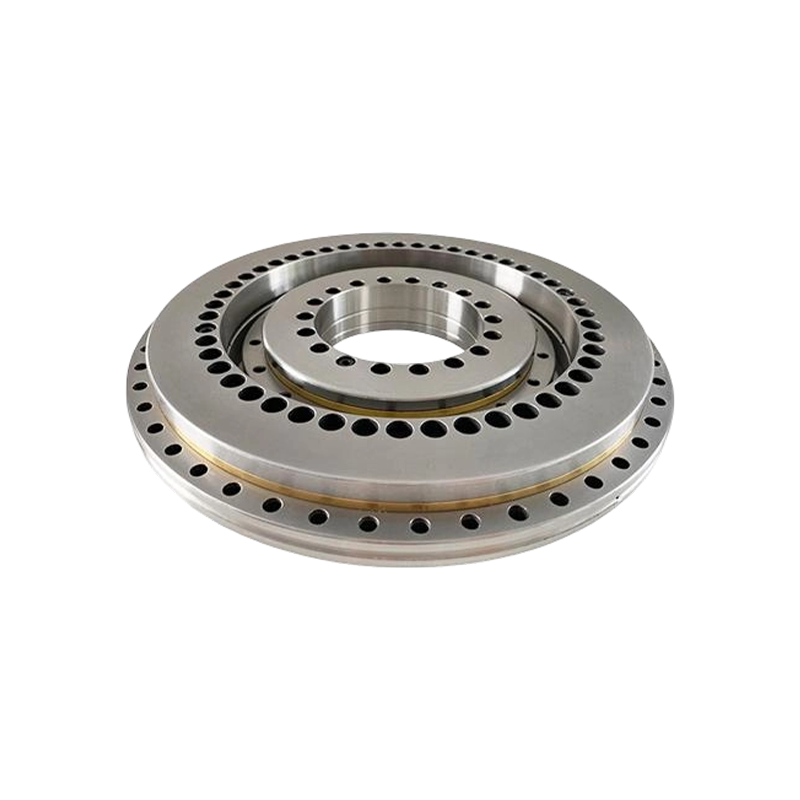
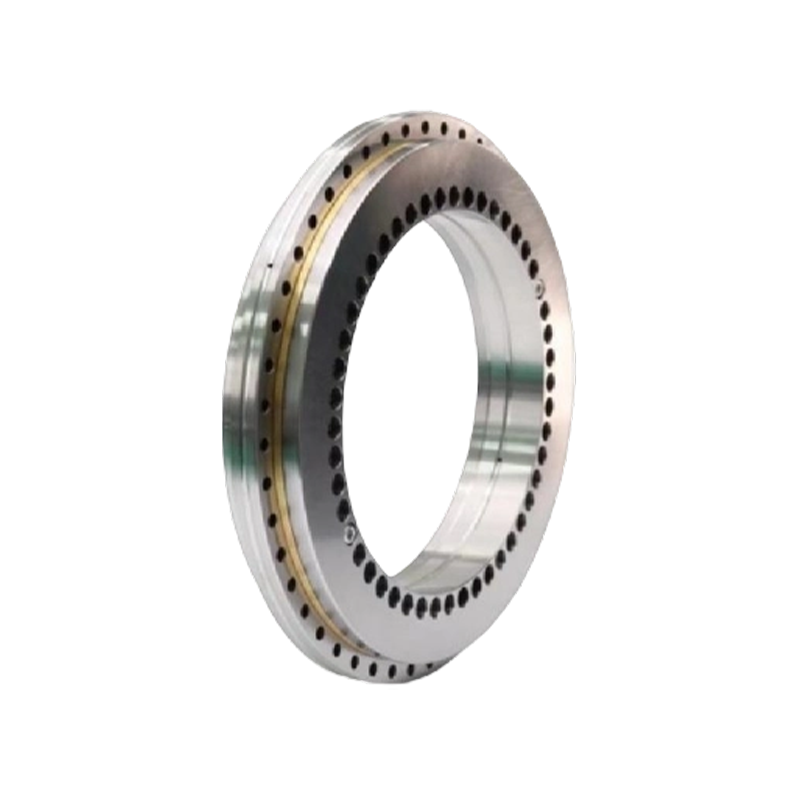
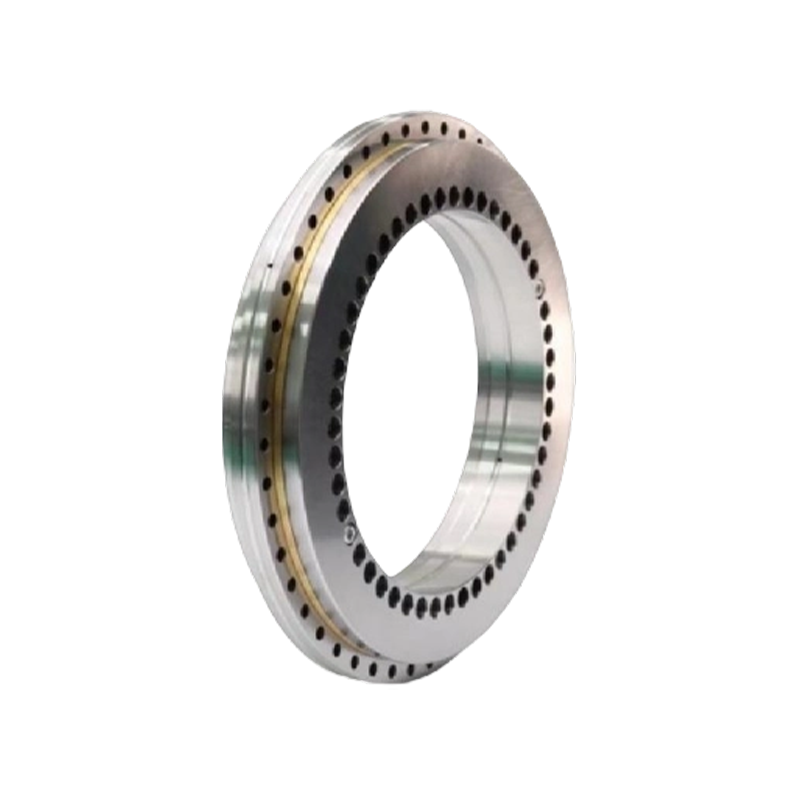
YRT Precision Turntable Bearing consist of a thrust/radial housing ring, a thrust/radial shaft ring, a thrust washer, two needle roller cage assemblies, and a set of radial cylindrical rollers. The housing ring and shaft ring have evenly distributed mounting screw holes. This type of bearing features high axial and radial load capacity, high rigidity, and very high precision.
Features of YRT Rotary Table Bearings:
1. Combined Bearing:
YRT bearings are combined bearings, integrating the functions of radial and thrust bearings. They can simultaneously withstand radial and axial loads from different directions and can also withstand torque.
2. High Precision:
YRT bearings typically have very high precision, enabling accurate rotation and positioning.
3. Rigidity:
YRT bearings have high rigidity, maintaining stability under high load conditions. Applications requiring heavy workloads ensure bearing reliability under high loads.
4. High Torque Capacity:
YRT bearings are designed to withstand high torque loads, crucial for applications requiring rotation and high torque transmission.
5. Easy Installation and Maintenance:
YRT bearings typically have a simple structure, facilitating installation and maintenance. This contributes to long-term bearing reliability.
Application Areas:
YRT bearings are widely used in various fields, including industrial robotic arms, machine tools, printing equipment, medical devices, and aerospace equipment. Their versatility and high performance make them a preferred choice for numerous engineering applications.
Precautions for Using YRT Turntable Bearings:
1. Keep the bearing and its surroundings clean
Even microscopic dust particles can negatively impact bearings.
2. Use with care
Strong impacts during use can cause scratches and indentations, leading to accidents.
3. Use appropriate tools
Avoid substituting existing tools; use only appropriate tools.
4. Be aware of bearing corrosion
Sweat on your hands can cause rust during operation, so be sure to use clean hands and wear gloves if possible.
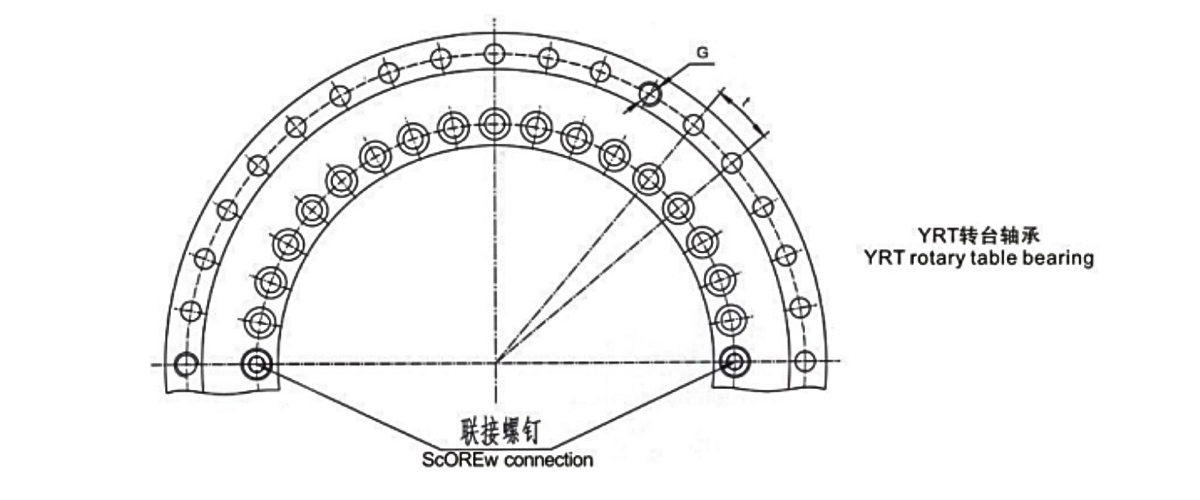
| Screw connection QTY |
Connect screws holes |
Pitch t |
Tightening torque of screw |
Basic rated load | Limited speed | Friction moment |
Weight | Bearing type | ||||
| Axial | Radial | |||||||||||
| Dynamic | Static | Dynamic | Static | |||||||||
| Ma | Ca | Coa | Cr | Cor | Grease Lubrication | |||||||
| G | QTY | QTYXt | Nm | KN | r/min | Nm | ≈Kg | |||||
| 2 | 一 | 一 | 12×30° | 8.5 | 38 | 158 | 28.5 | 49.5 | 600 | 2.5 | 1.6 | YRT50 |
| 2 | 一 | 一 | 12×30° | 8.5 | 56 | 255 | 42.5 | 100 | 530 | 3 | 2.4 | YRT80 |
| 2 | M5 | 3 | 18×20° | 8.5 | 76.5 | 415 | 47.5 | 120 | 430 | 3 | 4.1 | YRT100 |
| 2 | M8 | 3 | 24×15° | 14 | 102 | 540 | 52 | 143 | 340 | 7 | 5.3 | YRT120 |
| 2 | M8 | 3 | 36×10° | 14 | 112 | 630 | 56 | 170 | 320 | 10 | 6.2 | YRT150 |
| 2 | M8 | 3 | 48×75° | 14 | 118 | 710 | 69.5 | 200 | 280 | 12 | 7.7 | YRT180 |
| 2 | M8 | 3 | 48×75° | 14 | 120 | 765 | 81.5 | 220 | 260 | 14 | 9.7 | YRT200 |
| 2 | M12 | 3 | 36×10° | 34 | 160 | 1060 | 93 | 290 | 200 | 20 | 18.3 | YRT260 |
| 2 | M12 | 3 | 36×10° | 34 | 275 | 1930 | 120 | 345 | 170 | 40 | 25 | YRT325 |
| 2 | M12 | 3 | 48×75° | 34 | 300 | 2280 | 186 | 655 | 140 | 55 | 33 | YRT395 |
| 2 | M12 | 3 | 48×75° | 34 | 355 | 2800 | 200 | 765 | 120 | 70 | 45 | YRT460 |
| 2 | M12 | 6 | 48×75° | 68 | 490 | 4250 | 228 | 965 | 80 | 140 | 89 | YRT580 |
| 2 | M12 | 6 | 48×75° | 116 | 870 | 7400 | 430 | 1700 | 65 | 200 | 170 | YRT650 |
| 3 | M16 | 6 | 60×6° | 284 | 1000 | 10010 | 455 | 1800 | 50 | 300 | 253 | YRT850 |
| 3 | M16 | 6 | 60×6° | 284 | 1290 | 11400 | 530 | 2040 | 40 | 600 | 312 | YRT950 |
| 6 | M¹6 | 6 | 72×5° | 284 | 1380 | 12000 | 620 | 2650 | 35 | 800 | 375 | YRT1030 |
| 6 | M16 | 6 | 72×5 | 284 | 1435 | 12850 | 745 | 2800 | 25 | 1000 | 450 | YRT1200 |
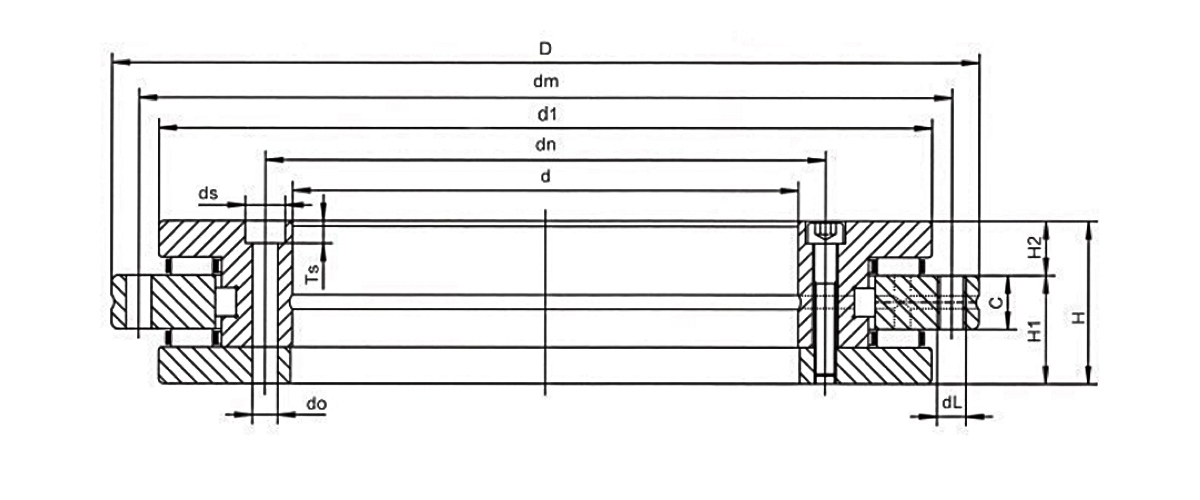
| Bearing type | Overall Dimension | The fixing holes | |||||||||||||
| d | D | H | H1 | H2 | C | d1 | dn | dm | Inner ring | Outside ring | |||||
| Unit: mm | do | ds | Ts | QTY | dL | QTY | |||||||||
| mm | mm | ||||||||||||||
| YRT50 | 50 | 126 | 30 | 20 | 10 | 10 | 105 | 63 | 116 | 5.6 | 9 | 4.2 | 10 | 5.6 | 12 |
| YRT80 | 80 | 146 | 35 | 23.35 | 11.65 | 12 | 130 | 92 | 138 | 5.6 | 10 | 4.2 | 10 | 4.6 | 12 |
| YRT100 | 100 | 185 | 38 | 25 | 13 | 12 | 160 | 112 | 170 | 5.6 | 10 | 5.4 | 16 | 5.6 | 15 |
| YRT120 | 120 | 210 | 40 | 26 | 14 | 12 | 184 | 135 | 195 | 7 | 11 | 6.2 | 22 | 7 | 21 |
| YRT150 | 150 | 240 | 40 | 26 | 14 | 12 | 214 | 165 | 225 | 7 | 11 | 6.2 | 34 | 7 | 33 |
| YRT180 | 180 | 280 | 43 | 29 | 14 | 15 | 244 | 194 | 260 | 7 | 11 | 6.2 | 46 | 7 | 45 |
| YRT200 | 200 | 300 | 45 | 30 | 15 | 15 | 274 | 215 | 285 | 7 | 11 | 6.2 | 46 | 7 | 45 |
| YRT260 | 260 | 385 | 55 | 36.5 | 18.5 | 18 | 345 | 280 | 365 | 9.3 | 15 | 8.2 | 34 | 9.3 | 33 |
| YRT325 | 325 | 450 | 60 | 40 | 20 | 20 | 415 | 342 | 430 | 9.3 | 15 | 8.2 | 34 | 9.3 | 33 |
| YRT395 | 395 | 525 | 65 | 42.5 | 22.5 | 20 | 486 | 415 | 505 | 9.3 | 15 | 8.2 | 46 | 9.3 | 45 |
| YRT460 | 460 | 600 | 70 | 46 | 24 | 22 | 560 | 482 | 580 | 10 | 15 | 8.2 | 46 | 10 | 45 |
| YRT580 | 580 | 750 | 90 | 60 | 30 | 30 | 700 | 610 | 720 | 11.4 | 18 | 11 | 46 | 11.4 | 42 |
| YRT650 | 650 | 870 | 122 | 78 | 44 | 34 | 800 | 680 | 830 | 14 | 20 | 13 | 45 | 14 | 42 |
| YRT850 | 850 | 1095 | 124 | 80.5 | 43.5 | 37 | 1018 | 690 | 1055 | 18.5 | 26 | 17 | 57 | 18.5 | 54 |
| YRT950 | 950 | 1200 | 132 | 86 | 46 | 40 | 1130 | 990 | 1160 | 18.5 | 26 | 17 | 57 | 18.5 | 54 |
| YRT1030 | 1030 | 1300 | 145 | 92.5 | 52.5 | 40 | 1215 | 1075 | 1255 | 18.5 | 26 | 17 | 66 | 18.5 | 66 |
| YRT1200 | 1200 | 1490 | 164 | 108 | 56 | 52 | 1410 | 1240 | 1445 | 18.5 | 26 | 17 | 66 | 18.5 | 66 |

0+
years
Industry Experience

0+
Model diversity

0+
Number of Employees

0
$
Annual export value

Why the 22205 e Bearing Matters in Heavy Equipment When engineers specify a double row spherical roller bearing for a demanding drive, the 22205 e bearing often appears near the top of the shortlist....
Engineers comparing 3200 a-2ztn9/mt33 double row angular contact ball bearings against other shaft support options usually start with one question: how do you keep a shaft rigid enough to resist til...
In the realm of precision motion control, the demand for bearings that can simultaneously handle axial, radial, and tilting moments is relentless. The ZKLDF100 bearings represent a specialized class ...
Understanding the XSU080168 Crossed Roller Bearing When precision, rigidity, and moment load capacity converge, the XSU080168 emerges as a critical component in rotating machinery. This thin-walled ...
Product Categories
Contact Us

Jane@ukl-bearing.com
Jenny@ukl-bearing.com
Andy@ukl-bearing.com
Ivy@ukl-bearing.com

+86-510- 88763239
+86-15371057968

No.1 Hehuan Road, Hudai Town, Binhu District, Wuxi City.
Ready to Begin?
Get in Touch

Now!

UKL BEARING
 English
 Español
 русский