
Content
We are living in a transformative period where automation is no longer a futuristic concept but a global industrial reality. From “lights-out” smart factories where production never sleeps, to high-precision surgical robots that assist in life-saving procedures, the shift toward autonomous systems is reshaping global industries. This transition demands a new standard of mechanical reliability, as machines are now expected to operate with higher speeds and greater autonomy than ever before.
In any robotic system, the bearing serves as the primary interface between stationary and moving parts. If the control system is the “brain” and the sensors are the “eyes,” the bearings are the joints that make physical movement possible. They are the silent enablers that manage friction, support structural loads, and ensure that every motor-driven command is translated into smooth, predictable motion.
Founded in 2020 and headquartered in the industrial hub of Wuxi, UKL Bearing Manufacturing Co., Ltd. is an integrated industrial and trading enterprise that combines R&D, production, and sales. We specialize in high-performance bearing solutions specifically engineered for the rigorous demands of modern robotics.
With a foundation built on over 15 years of OEM/ODM export experience, UKL provides the technical backbone for global industries that require uncompromising precision and reliability.
The following table summarizes the core strengths that position UKL as a leader in the bearing manufacturing sector for automation:
| Core Dimension | UKL Capability & Specification | Strategic Value to Clients |
|---|---|---|
| Experience | 15+ years of OEM/ODM expertise | Proven track record in international standards (Europe, Asia, MEA). |
| Infrastructure | Fully modernized production base in Wuxi | Complete control over forging, heat treatment, and grinding. |
| Human Capital | 200+ skilled professionals | Deep technical support and rapid customized engineering. |
| Quality Focus | High-performance precision manufacturing | Ensuring reliability in 24/7 automated environments. |
| Service Model | Integrated Industrial & Trading | Flexible supply chain and direct factory-to-client communication. |
At its core, the primary mechanical mission of a bearing is to minimize resistance. In automation, energy lost to friction is not just a waste of power—it is a source of wear and heat that can degrade system performance. By converting sliding friction into rolling friction, UKL bearings ensure that the maximum amount of torque generated by motors is used for movement rather than overcoming internal resistance.
In the design of mobile robotics, such as AGVs (Automated Guided Vehicles) and AMRs (Autonomous Mobile Robots), every watt of battery power is precious. Low-friction bearings allow for the use of smaller, lighter actuators and motors to move heavier payloads. This weight reduction creates a virtuous cycle: less weight requires less energy to move, which in turn extends the battery life and operational cycles of the robot.
Continuous 24/7 operation in a smart factory environment generates significant thermal energy. High-quality precision bearings are essential for preventing thermal expansion. When bearings generate excessive heat, metal components expand, leading to a loss of tolerance and potential mechanical seizure. UKL’s precision-engineered raceways ensure minimal heat generation, maintaining the “thermal health” of the entire robotic assembly.
The table below illustrates how friction reduction impacts various performance metrics in an automated system:
| Performance Metric | Standard Industrial Bearing | UKL High-Precision Bearing | Benefit to Automation |
|---|---|---|---|
| Coefficient of Friction | Moderate | Ultra-Low | Reduced motor torque requirements. |
| Operating Temperature | High (Varies with load) | Low & Stable | Prevents precision drift due to heat. |
| Battery Life (Mobile Robots) | Standard Baseline | 10–15% Improvement | More missions per charge cycle. |
| Start-Stop Smoothness | Occasional “Stiction” | Fluid & Instant | Eliminates jitter in delicate movements. |
| Noise Level (dB) | Moderate Vibration | Silent Operation | Ideal for service and medical robots. |
In high-end automation, a robot is often required to return to the exact same spatial coordinate millions of times. Even a few microns of error can result in a failed weld, a broken microchip, or a surgical error. High-precision bearings (specifically P4 and P2 grades) are engineered with extremely tight tolerances to eliminate internal play or “backlash,” ensuring that every command from the controller is executed with absolute fidelity.
Delicate tasks, such as electronic component assembly or liquid handling in labs, require consistent torque. Lower-quality bearings often suffer from torque fluctuations, which manifest as “jitter” or micro-vibrations at the robot’s end-effector. UKL’s advanced grinding processes ensure that raceways are perfectly smooth, providing the fluid motion necessary for vibration-sensitive applications.
To ensure zero clearance and maximum positional stability, UKL utilizes specialized preloading techniques. By applying a controlled internal load to the bearing during assembly, we eliminate any structural “give.” This results in a rigid joint that can withstand external forces without shifting, which is critical for maintaining the accuracy of robotic arms under heavy payloads.
The following table explains the relationship between bearing precision grades and their typical application within an automated system:
| Precision Grade (ISO/DIN) | Tolerance Level | Typical Robotic Application | Precision Requirement |
|---|---|---|---|
| P5 (Class 5) | Standard Precision | Conveyor belts, heavy-duty AGV wheels | General positioning |
| P4 (Class 4) | High Precision | SCARA robots, pick-and-place arms | Sub-millimeter accuracy |
| P2 (Class 2) | Ultra Precision | Surgical robots, semiconductor assembly | Sub-micron repeatability |
| Feature | Standard Bearings | UKL Precision Bearings |
|---|---|---|
| Radial Runout | Higher (potential for wobble) | Minimal (ensures center-point stability) |
| Starting Torque | Inconsistent | Low and Uniform |
| Positional Drift | Increases over time | Zero-drift design |
Unlike traditional machinery where motion is often linear or fixed in a single plane, modern robots move in 3D space. This creates a challenging mechanical environment where joints must simultaneously handle radial loads (perpendicular to the shaft), axial loads (parallel to the shaft), and moment loads (tilting or overturning forces). As a robotic arm extends, the leverage increases the moment load exponentially, requiring bearings that can maintain structural integrity without deforming.
To address these complex forces while keeping the robot lightweight and compact, UKL provides specialized bearing geometries:
Understanding which bearing to use for specific robotic “anatomy” is crucial for performance and longevity:
| Robotic Component | Loading Environment | Recommended UKL Bearing | Mechanical Advantage |
|---|---|---|---|
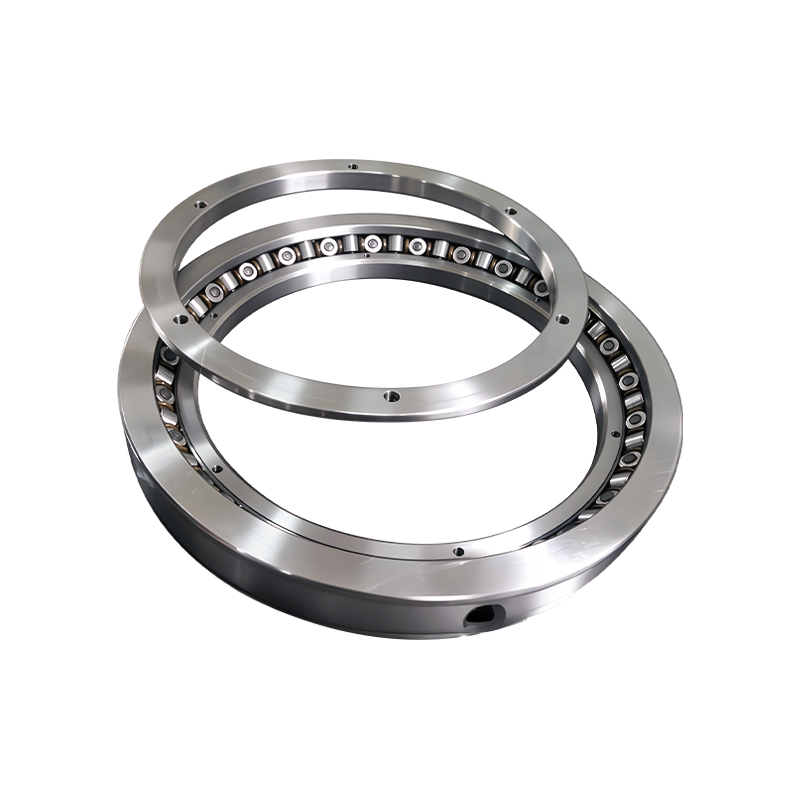
| Waist / Base Joint | Heavy tilting & axial loads | Crossed Roller Bearing | Replaces two bearings with one; high rigidity. |
| Wrist / End Effector | Multi-directional, high speed | Angular Contact Ball Bearing | Supports high-speed precision during rotation. |
| Harmonic Drive | Space-constrained, radial | Thin-Section Bearing | Extremely lightweight; fits into compact gearboxes. |
| AGV Drive Wheels | High radial & shock loads | Deep Groove / Tapered Roller | Durable under heavy payload and floor impact. |
| Linear Actuators | High axial thrust | Thrust Ball / Needle Bearings | Converts rotary motion to linear force efficiently. |
| Bearing Type | Radial Load | Axial Load | Moment (Tilting) Load | Space Efficiency |
|---|---|---|---|---|
| Deep Groove Ball | Good | Fair | Poor | Moderate |
| Crossed Roller | Excellent | Excellent | Superior | High |
| Thin-Section | Fair | Fair | Good | Excellent |
In an automated production line, time is literally money. A single bearing failure in a primary robotic arm can halt an entire assembly process, resulting in losses that can reach thousands of dollars per hour. UKL focuses on “Extreme Reliability”—engineering components that don’t just work, but work consistently for millions of cycles without requiring human intervention.
The longevity of a bearing is largely determined by its internal environment.
Automation occurs in vastly different environments. A bearing in a semiconductor cleanroom must not “outgas” or shed particles, while a bearing in a foundry must survive extreme heat and abrasive dust. UKL provides customized material treatments and coatings to match these harsh conditions.
The following table highlights how UKL’s specialized features extend the service life of automated systems:
| Feature | Standard Bearing | UKL “Maintenance-Free” Solution | Impact on Automation |
|---|---|---|---|
| Lubrication Cycle | Frequent manual regreasing | Lifetime lubrication (Sealed) | Eliminates scheduled downtime. |
| Sealing Efficiency | Basic rubber seals | Nilos Rings / Multi-lip Seals | Prevents contamination in dusty warehouses. |
| Material Integrity | Standard Chrome Steel | Vacuum Degassed / Heat Treated | Reduces fatigue and prevents “spalling.” |
| Chemical Resistance | Low | Optional Ceramic/Stainless/Coated | Suitable for pharmaceutical washdowns. |
| Expected Service Life | 10,000 hours | 30,000+ hours (Application dependent) | Lowers Total Cost of Ownership (TCO). |
| Industry Environment | Key Challenge | UKL Solution |
|---|---|---|
| Pharmaceutical | Sterile washdowns/Chemicals | Stainless Steel (440C) + Food-grade Grease |
| Semiconductor | Particle contamination | Ceramic Hybrid Bearings (Cleanroom Rated) |
| Logistics/Warehousing | Dust and debris | Heavy-duty Double-Lip Contact Seals |
| Heavy Manufacturing | High Heat / Vibration | High-Temperature Stabilized Heat Treatment |
While UKL was formally established in 2020, our foundation is built on over 15 years of deep industry experience. This long-standing expertise in the OEM/ODM sector allows us to act as more than just a vendor; we are a global technical partner. We understand the international quality standards required by automation integrators in Europe, Asia, Africa, and the Middle East, ensuring that every exported component meets the highest global benchmarks.
Located in Wuxi—a world-renowned hub for bearing production—our modernized facility is equipped to handle the entire manufacturing process in-house. This “full-cycle” control is the secret to our reliability. By managing everything from raw material forging to final automated assembly, we eliminate the quality variances that plague smaller, outsourced operations.
Automation is evolving rapidly, and standard “off-the-shelf” bearings aren’t always the answer. UKL’s team of 200+ professionals specializes in customized engineering. Whether it’s modifying a raceway for higher speed or developing a unique housing for a specialized robotic arm, we collaborate directly with engineers to optimize their designs for the real world.
The table below outlines our internal capabilities and how they translate to direct value for the customer:
| Production Stage | UKL Capability | Value to the Customer |
|---|---|---|
| R&D & Design | Custom CAD/CAM Engineering | Tailor-made solutions for unique robotic joints. |
| Heat Treatment | Fully Controlled In-house Process | Maximum durability and fatigue life. |
| Precision Grinding | Automated CNC Grinding Lines | Consistency across high-volume orders. |
| Quality Control | 100% Automated Testing | Guaranteed P4/P2 precision grades. |
| Global Logistics | Integrated Industrial & Trading | Fast, duty-efficient shipping to global markets. |
| Feature | UKL Bearing (Wuxi) | Benefits |
|---|---|---|
| Professional Team | 200+ Skilled Staff | Deep technical support and problem-solving. |
| Manufacturing Base | Modernized & Integrated | Full control over the supply chain and quality. |
| Customization | Flexible OEM/ODM Service | Ability to produce niche or specialized bearings. |
| Response Speed | Integrated Trading Enterprise | Rapid quoting and short lead times. |
In the intricate world of robotics and automation, the bearing is far more than a simple mechanical component; it is the fundamental enabler of movement. As we have explored, without the precision, friction reduction, and load-handling capabilities provided by high-performance bearings, the levels of speed, accuracy, and safety required by modern industry would be fundamentally impossible.
From the surgical precision of medical robots to the rugged endurance of AGVs in a warehouse, the right bearing choice directly dictates the efficiency, lifespan, and reliability of the entire autonomous system.
At UKL Bearing Manufacturing Co., Ltd. (Wuxi), we recognize that our components are the “joints” upon which your innovations move. By combining 15 years of export expertise with a state-of-the-art, integrated production facility, we deliver the precision and durability that the future of automation demands. Our commitment to P4/P2 grade accuracy and maintenance-free operation ensures that your robots remain productive, day and night.
| Strategic Goal | Mechanical Requirement | UKL Solution |
|---|---|---|
| Energy Efficiency | Ultra-low friction | High-performance rolling elements & synthetic lubrication. |
| High Repeatability | Zero backlash | Precision-preloaded P4/P2 grade bearings. |
| Space Optimization | High power density | Thin-section and Crossed Roller designs. |
| Operational Uptime | Long service life | Advanced sealing and specialized heat treatment. |
| Design Flexibility | Custom specifications | Full OEM/ODM technical partnership and R&D. |
1. Why is bearing “precision grade” (P4/P2) so important for robotics?
In robotics, precision grades like P4 or P2 (ISO/DIN standards) refer to extremely tight tolerances in dimensions and rotation. These grades are essential because they minimize “runout” (wobble) and “backlash” (play). High-precision bearings ensure that a robotic arm can repeat the same movement within microns, which is critical for tasks like semiconductor assembly or surgical procedures.
2. How do bearings help in extending the battery life of mobile robots (AGVs/AMRs)?
Bearings extend battery life by maximizing mechanical efficiency. By converting sliding friction into ultra-low rolling friction, UKL bearings reduce the torque required from the motors to initiate and maintain movement. When motors draw less current to overcome internal resistance, the robot can operate for longer durations on a single charge.
3. What makes Crossed Roller Bearings the preferred choice for robotic joints?
Unlike standard ball bearings, Crossed Roller Bearings feature rollers arranged at 90-degree angles to each other in a single raceway. This design allows a single bearing to handle radial, axial, and moment (tilting) loads simultaneously. This space-saving design provides the high rigidity and compactness required for the “waist” or “shoulder” joints of industrial robots.
4. Can UKL bearings operate in specialized environments like cleanrooms or washdown areas?
Yes. For sterile or sensitive environments, we offer customized solutions including stainless steel materials (440C), ceramic hybrid balls, and food-grade or vacuum-rated lubricants. We also utilize specialized sealing (like Nilos Rings) to prevent particle shedding or grease leakage, meeting the strict requirements of pharmaceutical and semiconductor industries.
5. How does UKL ensure the quality of its bearings for high-demand automation?
Quality is maintained through full-lifecycle control at our Wuxi production base. This includes using vacuum-degassed steel, strictly controlled in-house heat treatment for optimal hardness, and 100% automated inspection for noise, vibration, and dimensional accuracy before shipping.


Product Categories
Contact Us

Jane@ukl-bearing.com
Jenny@ukl-bearing.com
Andy@ukl-bearing.com
Ivy@ukl-bearing.com

+86-510- 88763239
+86-15371057968

No.1 Hehuan Road, Hudai Town, Binhu District, Wuxi City.
Ready to Begin?
Get in Touch

Now!
UKL BEARING
 English
 Español
 русский
