Content
Robot joints operate under a unique combination of constraints. They must be lightweight, yet rigid enough to resist deflection under load. They must rotate with micron-level precision, yet survive thousands of cycles per day. And they must handle radial, axial, and moment loads simultaneously, often within a footprint no larger than a few centimeters. This is where RB2508 bearing enters the picture.
As a thin-section crossed roller bearing measuring 25 mm bore, 41 mm outer diameter, and just 8 mm width, the RB2508 is engineered for exactly this kind of high-density, high-stakes application. It is not simply a component; it is a design decision that affects the robot's repeatability, thermal behavior, and maintenance interval. This article examines the technical reasoning behind the RB2508, its structural advantages, selection criteria, and how to evaluate it for robot arm integration.
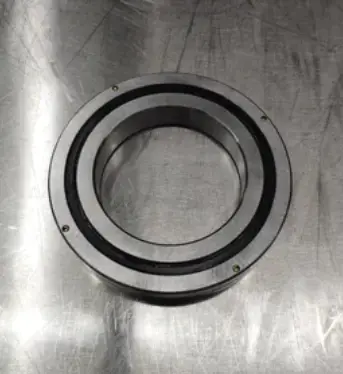
In robot joints, the bearing is not a passive part. It defines the stiffness chain and directly influences absolute positioning accuracy.
Traditional robot joints often rely on a combination of deep groove ball bearings, angular contact pairs, or tapered roller bearings. Each of these handles a limited load direction well, but they require careful preload adjustment and consume more axial space. The RB2508 takes a different path.
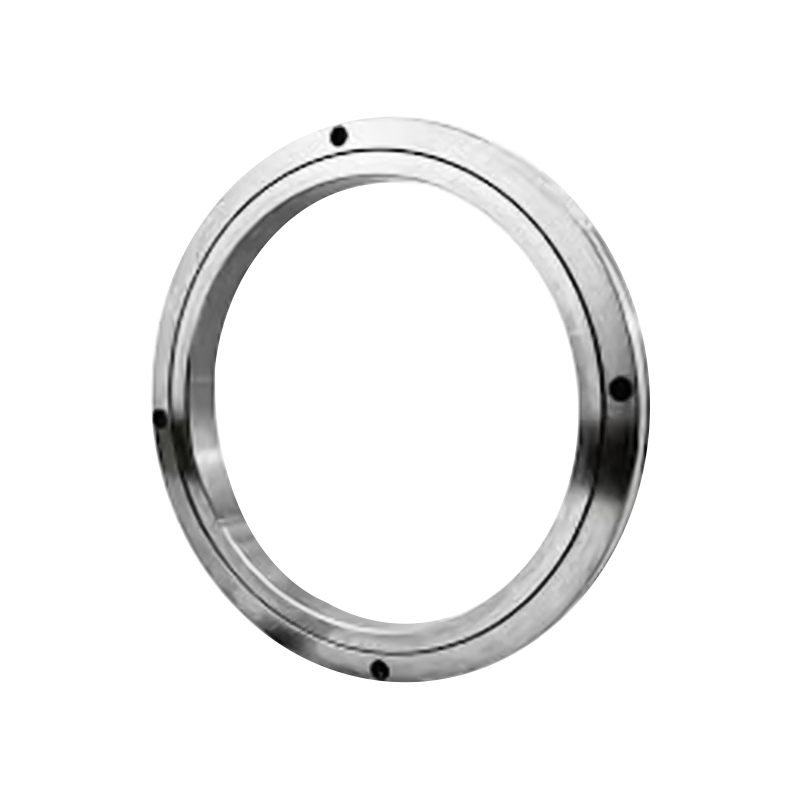
In a crossed roller bearing, cylindrical rollers are arranged at 90-degree intervals within a V-shaped groove. This orientation allows a single bearing to absorb radial loads, axial loads in both directions, and tilting moment loads simultaneously. For a robot joint, this translates to a simpler housing design, fewer components, and a shorter axial stack.
The RB2508 uses a split outer ring and a one-piece inner ring. This configuration is particularly suitable when the inner ring rotation accuracy is critical, which is common in robot joints where the inner ring connects to the output flange or harmonic drive. The split outer ring allows for preload adjustment during assembly, while the integral inner ring maintains roundness and rigidity.
With a 25 mm bore and 8 mm width, the RB2508 is classified as a thin-section bearing. Thin-section bearings are prone to deformation if handled or installed incorrectly, but when properly supported, they offer an excellent stiffness-to-weight ratio. The crossed roller layout compensates for the reduced wall thickness by distributing load across a larger number of rolling elements.
Before integrating the RB2508 into a robot joint, engineers should review its core dimensions and load ratings. The table below summarizes the essential parameters.
| Parameter | Value |
|---|---|
| Bore diameter (d) | 25 mm |
| Outer diameter (D) | 41 mm |
| Width (B) | 8 mm |
| Roller pitch circle diameter (dp) | 32 mm |
| Inner ring shoulder (ds) | 28.5 mm |
| Outer ring shoulder (Dh) | 35.5 mm |
| Basic dynamic load rating (C) | 3.63 kN |
| Basic static load rating (C0) | 3.83 kN |
| Weight | Approximately 0.05 kg |
The RB2508 is often specified with suffixes that define sealing, clearance, and precision. Common combinations include:
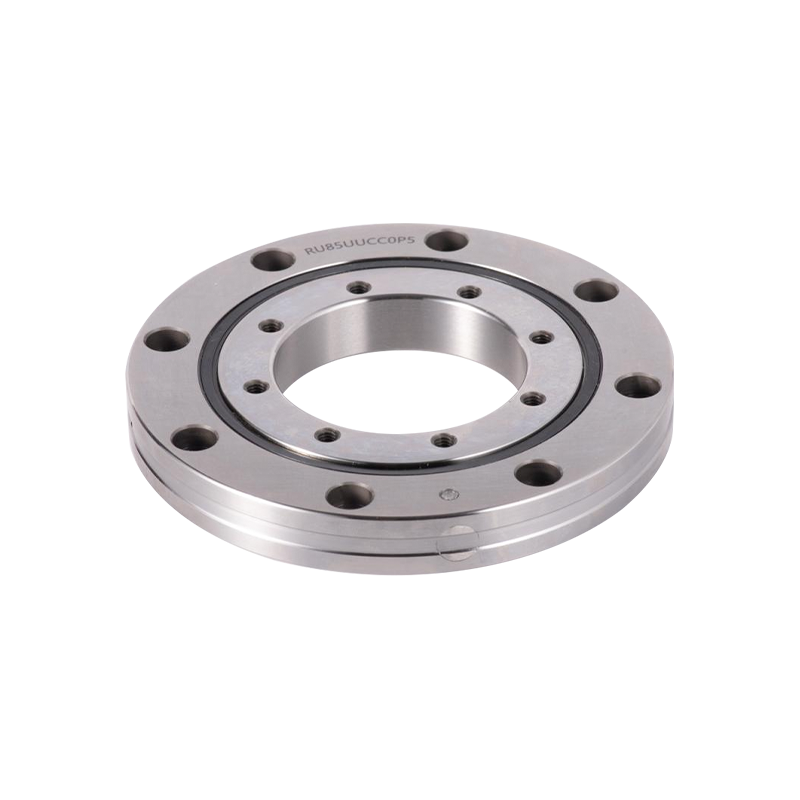
For example, RB2508UUCC0P5 denotes a double-sealed, preloaded bearing with P5 precision. Selecting the wrong clearance or precision grade can lead to excessive friction, heat generation, or insufficient stiffness for the robot's control loop.
Thin-section bearings are sensitive to mounting-induced distortion. If the housing or shaft shoulder is not machined to the correct flatness and perpendicularity, the raceway can deform, causing torque ripple and premature fatigue. This is not a defect of the bearing; it is a system-level requirement. Engineers should verify housing tolerances and consider using a controlled mounting procedure.
The RB2508 is widely used in industrial robot joints, rotary axes, and precision positioning stages. Its ability to carry combined loads in a compact envelope makes it a natural fit for collaborative robots, SCARA arms, and end-effectors where space is at a premium.
In a robot joint, axial and radial runout directly affect the tool center point accuracy. A crossed roller bearing with tight tolerances minimizes these deviations, allowing the controller to maintain repeatability over millions of cycles. The preloaded CC0 variant is often chosen for this reason, as it removes internal clearance and increases the effective stiffness of the joint.
Robot joints rarely see constant load. They experience frequent starts, stops, and changes in payload. The RB2508's rolling element geometry distributes contact stress across a larger area than ball bearings of similar size, which can extend fatigue life in oscillating or variable-load conditions. While exact life calculations depend on the specific load spectrum, the fundamental advantage lies in the line contact of cylindrical rollers versus point contact of balls.
Typical Applications:
Pricing for the RB2508 depends on several factors: precision grade (P5, P4, P2), clearance or preload (C0, CC0), sealing option (UU or open), and order quantity. Because these variables affect both manufacturing cost and lead time, a generic price list is rarely accurate.
To receive a meaningful quotation, prepare the following information:
Suppliers with engineering support can also assist with non-standard dimensions, custom preload, and installation guidance. When evaluating a supplier, ask whether they can provide 3D models, dimensional drawings, and technical consultation for the specific joint design.
The basic dynamic load rating (C) is 3.63 kN, and the basic static load rating (C0) is 3.83 kN.
Dimensionally, it may interchange with other 25x41x8 mm crossed roller bearings. However, precision grade, clearance, and internal design can vary. Always verify the suffix code and performance requirements before substitution.
Ensure the housing and shaft shoulders are flat and perpendicular. Avoid forcing the bearing during assembly, and follow the recommended tightening sequence. For thin-section bearings, mounting distortion is a common cause of accuracy loss.
Many suppliers offer 3D STEP files and 2D drawings upon request. These are useful for integration into robot joint design and for verifying fit before ordering.
Product Categories
Contact Us

Jane@ukl-bearing.com
Jenny@ukl-bearing.com
Andy@ukl-bearing.com
Ivy@ukl-bearing.com

+86-510- 88763239
+86-15371057968

No.1 Hehuan Road, Hudai Town, Binhu District, Wuxi City.
Ready to Begin?
Get in Touch

Now!
UKL BEARING
 English
 Español
 русский