Content
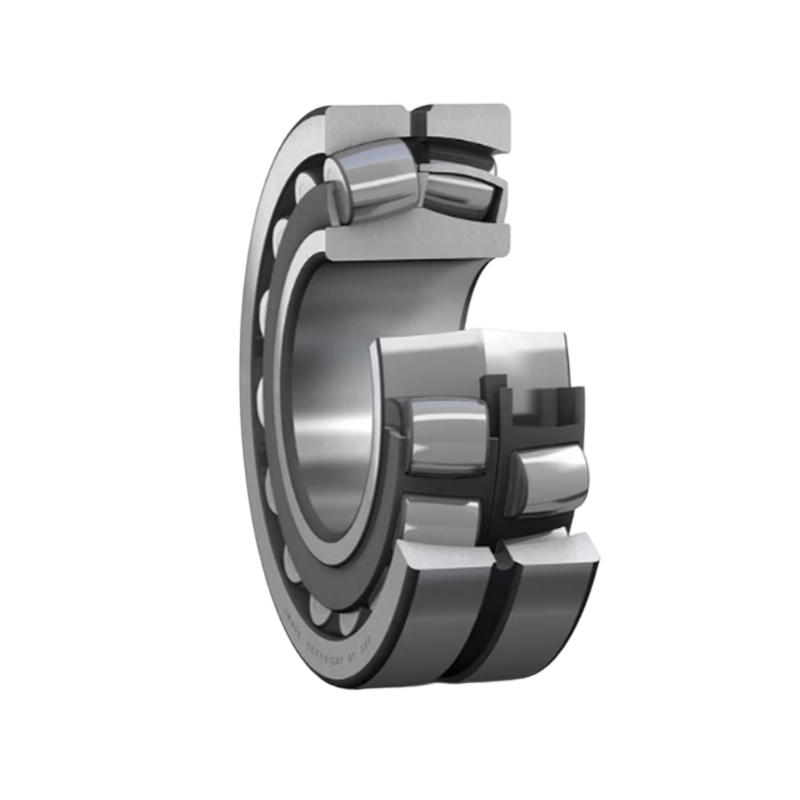
When engineers specify a double row spherical roller bearing for a demanding drive, the 22205 e bearing often appears near the top of the shortlist. It belongs to the widely used 222 series, whose boundary dimensions follow the international ISO standard. That means a 22205 e bearing can usually replace an existing unit in a housing without redesigning the shaft, which shortens maintenance shutdowns.
Heavy machinery rarely runs in ideal conditions. Shafts bend under load, housings are not always machined perfectly, and vibration is constant. The spherical roller design was developed for exactly these conditions. This guide covers geometry, rated loads, speed and temperature limits, design advantages, variants, applications, installation practice, causes of early failure, and sourcing, so buyers and maintenance engineers can make a sound technical decision.
The envelope of the bearing is defined by its bore, outside diameter and width. The 22205 e bearing has a 25 mm bore, a 52 mm outside diameter and an 18 mm width, a 25x52x18 mm unit that matches the common 222 series footprint.
| Item | Parameter |
|---|---|
| Bore d | 25 mm |
| Outside diameter D | 52 mm |
| Width B | 18 mm |
| Minimum fillet radius r | 1 mm |
| Weight | About 0.17 to 0.18 kg |
| Structure type | Double row spherical roller, open type without seals |
| Cage | Pressed steel window type cage |
| Bore form | Cylindrical bore as standard, 1:12 tapered bore in the EK version |
| Outer ring | Built-in lubrication groove and lubrication hole (W33 structure) |
The bearing uses two rows of spherical rollers running on a spherical outer ring raceway. This geometry lets the inner ring and rollers tilt relative to the outer ring, which gives the bearing its self-aligning behavior. The pressed steel cage keeps the rollers evenly spaced and keeps friction low at operating speed. Because the bearing is open without seals, external sealing is needed to keep contaminants out.
Correct shoulder design is essential for seating the bearing squarely. A shoulder that is too small or a fillet that is too large will stop the ring from seating fully.
| Mounting Item | Value |
|---|---|
| Minimum shaft shoulder diameter da | 30.6 mm |
| Maximum housing shoulder diameter Da | 46.4 mm |
| Maximum shaft or housing fillet radius ra | 1 mm |
Rating data shows how the bearing will behave in real operation. The basic dynamic load rating is the figure used to estimate fatigue life under rotating load. The basic static load rating defines the load a stationary or very slow bearing can carry without permanent deformation. The fatigue load limit marks the level below which fatigue damage is not expected under normal conditions.
| Performance Item | Value |
|---|---|
| Basic dynamic load rating Cr | 49.9 kN |
| Basic static load rating C0r | 44.0 kN |
| Fatigue load limit Pu | 4.75 kN |
| Reference speed with grease lubrication | 13000 r/min |
| Limiting speed | 17000 r/min |
| Misalignment allowance | Plus or minus 1.5 degrees |
| Calculation factor e | 0.35 |
| Operating temperature range | Minus 30 to plus 120 degrees Celsius |
Speed capability must be read together with lubrication. The reference speed applies to grease lubrication under normal conditions, while the limiting speed assumes excellent lubrication and cooling. Running near the limit generates heat and accelerates grease breakdown, so most designers keep actual operation well below it. The calculation factor e is listed so engineers can compare sizes within the series consistently.
Design rule of thumb: select the bearing by load and life first, then check speed and temperature against the limits above, and allow margin for shock.
The 22205 EK has a 1:12 tapered bore and is mounted with a locking sleeve. The taper allows controlled fit adjustment and removal without heating, which suits plain shafts where precise fit control is needed.
The 22205 E/C3 is a C3 large clearance variant with extra internal play. The added clearance absorbs thermal expansion, so it is preferred for vibrating equipment and high temperature environments where the inner ring runs warmer than the outer ring.
Standard C0 clearance suits general equipment at moderate temperatures with a snug fit. Choose C3 when the bearing sees vibration, a heated shaft or a tight interference fit that reduces internal play. Avoid selecting less clearance than the application needs, because too little play causes heat buildup and early fatigue.
The core difference is the bore. The cylindrical 22205 E mounts directly on a plain shaft by heating or pressing. The tapered 22205 EK mounts on a locking sleeve. The two versions are not interchangeable on the same shaft, so confirm the bore form on the drawing before ordering.
The 22205 e bearing is used across several sectors where loads are heavy and conditions are imperfect:
This bearing suits heavy loads, shaft deflection, installation errors and periodic relubrication. It is not suited to extremely high speed applications.
Good installation practice protects the design advantages described above. Follow these key points:
The outer ring groove and hole let technicians relubricate without stopping the machine, but the interval must be set by the operating conditions. Temperature, speed, load, dust exposure and running hours all change how fast grease degrades. Start with a conservative schedule, record the condition at each service, and extend or shorten the interval based on the results. Adding grease in small, regular amounts is generally better than large irregular charges, which can raise internal pressure and temperature.
Most early failures can be traced to a small number of avoidable causes:
In a typical field case, a conveyor drive bearing failed within a short period because the seals were missing and dust entered the raceway. Adding external seals and a regular relubrication schedule extended service life considerably.
A structured selection path reduces errors. Start with the load, check speed and temperature, confirm the fit, and then plan lubrication and care.
Begin by defining the radial and axial load, including shock. Next check the reference and limiting speeds against the operating speed. Then confirm the shoulder diameters, fillet radius and bore form. Finally set the seal, clearance and lubrication plan so the bearing performs as specified over its life.
Buyers looking for a wholesale source should evaluate more than unit price. A capable manufacturer provides a dimensional report, confirms load ratings with test data, offers the clearance and bore options you need, and maintains traceability for each batch. For bulk orders, ask about packaging, lead times and consistency between production runs. For projects that need a modified design, check whether the supplier accepts custom specifications for seals, cage material or lubrication features. Reviewing the spherical roller bearings range, including the standard and EK versions, helps you compare options within one supplier.
The 22205 e has a cylindrical bore and is heated or pressed onto a plain shaft. The 22205 EK has a 1:12 tapered bore and mounts on a locking sleeve, which allows controlled fit and easier removal.
Yes. The spherical outer raceway tolerates misalignment of plus or minus 1.5 degrees. Deviation should still be minimized during installation, because sustained misalignment shortens service life.
The C3 clearance version is generally preferred for vibrating equipment and high temperature conditions, since the extra internal play absorbs thermal expansion and vibration.
The most common causes are misalignment beyond the allowance, incorrect fit, poor or contaminated lubrication, operation outside the temperature range, sustained shock and incorrect clearance.
Check the bore of 25 mm, outside diameter of 52 mm and width of 18 mm. Also verify that the shaft shoulder is at least 30.6 mm and the housing shoulder is no larger than 46.4 mm.
Many manufacturers offer bulk orders and OEM or ODM services. Request a dimensional report, load rating documentation and sample testing before committing to a larger order.
Product Categories
Contact Us

Jane@ukl-bearing.com
Jenny@ukl-bearing.com
Andy@ukl-bearing.com
Ivy@ukl-bearing.com

+86-510- 88763239
+86-15371057968

No.1 Hehuan Road, Hudai Town, Binhu District, Wuxi City.
Ready to Begin?
Get in Touch

Now!
UKL BEARING
 English
 Español
 русский